
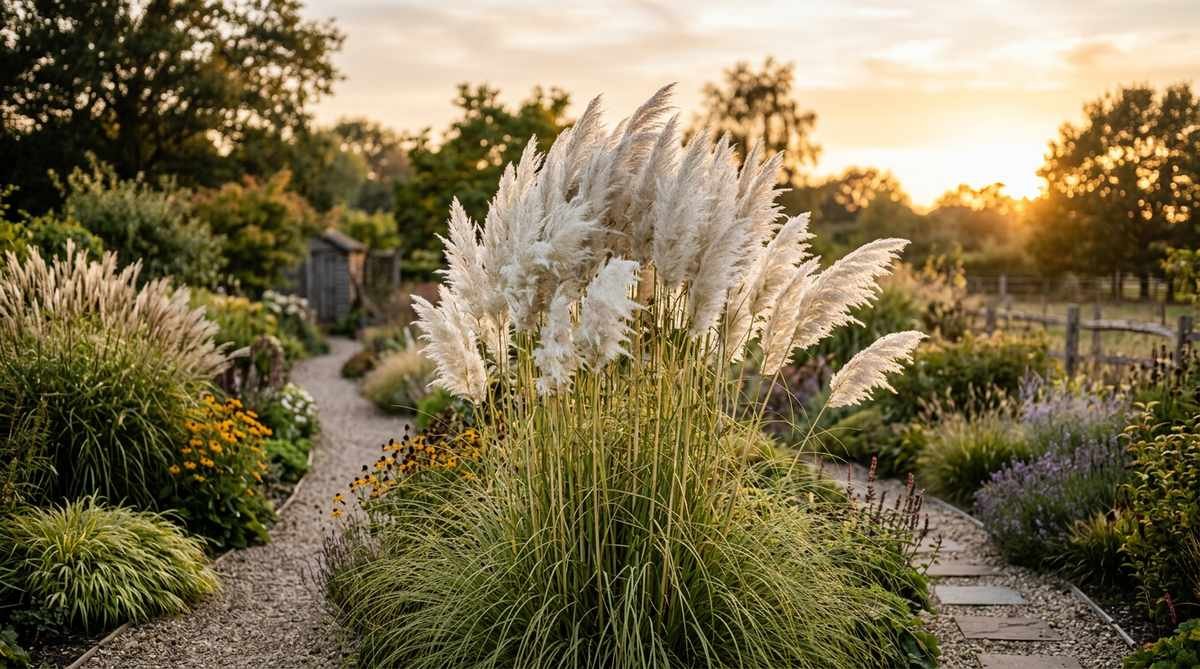
Pampas grass (Cortaderia selloana) is a large perennial ornamental grass native to South America that grows 8 to 13 feet tall and produces dramatic silvery-white plumes from late summer through fall. Hardy in USDA zones 7 through 10, it thrives in full sun with minimal watering once established, making this pampas grass plant one of the most low-maintenance ornamental choices for warm-climate gardens.
What Is the Pampas Grass Plant?
Pampas grass is a clump-forming perennial in the family Poaceae, originating from the grasslands of Argentina, Brazil, and Uruguay. Its botanical name, Cortaderia selloana, comes from the Spanish cortar meaning “to cut,” a nod to its razor-sharp leaf margins. The plant forms dense tussocks of long, arching, blue-green blades that can reach 4 feet tall before culms (flower stems) shoot upward to tower over surrounding plants.
Plants are either female or hermaphroditic (functionally male). Female plants produce the feathery, silky plumes most associated with the species. The inflorescence, called a panicle, ranges from 1 to 3 feet in length and persists well into winter, shimmering in the wind long after other plants have gone dormant. Florists who use dried pampas grass specifically seek out female plants for this reason: the silky hairs covering each floret on a female plume give bouquets and dried arrangements a fullness that male plumes simply cannot match.
| Plant Detail | Specification |
|---|---|
| Botanical Name | Cortaderia selloana |
| Family | Poaceae |
| Plant Type | Perennial grass |
| Mature Height | 8–13 ft (culms); 4 ft (leaf tussock) |
| Mature Width | 4–6 ft |
| Sun Exposure | Full sun (6+ hours daily) |
| Soil pH | 6.0–7.5 (acidic to slightly alkaline) |
| Soil Type | Moist but well-drained |
| Bloom Time | Late summer through fall |
| Hardiness Zones | USDA 7–10 |
| Native Region | Argentina, Brazil, Uruguay |
How to Grow Pampas Grass
Pampas grass grows best in full sun with well-drained soil and tolerates drought, coastal salt spray, and poor soils with minimal intervention. Plant it in late spring after the last frost date has passed; this gives roots time to establish before summer heat arrives. Space plants at least 6 feet apart to allow for the clump’s eventual spread.
Light and Location
A minimum of six hours of direct sunlight daily is non-negotiable for good plume production. Plants in partial shade become floppy, bloom sparingly, and are more susceptible to fungal issues. Coastal exposures work well; pampas grass tolerates salt spray better than most ornamental grasses, which explains why beach plantings in the Southeast remain popular.
Choose the location carefully before planting. Once established, moving a mature clump is a significant undertaking. The site should also be well away from structures, as the plant is highly flammable when dry; a minimum of 10 feet from a home, fence, or outdoor grill is standard guidance from fire safety resources.
Soil and Watering
Pampas grass adapts to a wide range of soil types, from sandy coastal soils to clay-heavy garden beds, as long as drainage is adequate. According to the NC State Extension Gardener Plant Toolbox, the preferred pH range is 6.0 to 7.5. In sandy or particularly dry soils, working in compost at planting time helps retain early moisture while roots get established.
Once established (typically after the first full growing season), pampas grass requires little supplemental irrigation in most of its hardiness range. Deep, infrequent watering is preferable to frequent shallow watering, which encourages shallow root development. During prolonged summer drought, one or two deep soakings per month is usually sufficient.
Fertilizer
Pampas grass is not a heavy feeder. A single application of a balanced slow-release fertilizer in early spring, just as new growth emerges, is typically all it needs. Over-fertilizing with nitrogen-heavy products encourages lush foliar growth at the expense of plume production and can make the plant more prone to flopping in wind.
Pampas Grass Varieties Worth Knowing
The standard species (Cortaderia selloana) reaches 10 to 13 feet but several cultivars offer smaller sizes or different plume colors. Choosing the right pampas grass plant variety matters particularly in states where the species has invasive potential, because some cultivars are sterile and cannot spread by seed.
| Variety | Height | Plume Color | Fertile? | Best For |
|---|---|---|---|---|
| Standard (C. selloana) | 10–13 ft | Silvery white | Yes | Large screening, full-scale drama |
| ‘Pumila’ (Dwarf) | 4–6 ft | Creamy white | No (sterile) | Smaller gardens, invasive-risk states |
| ‘Rosea’ | 8–10 ft | Soft pink | Yes | Color contrast in garden beds |
| ‘Sunningdale Silver’ | 10–12 ft | Large silver-white | Yes | Maximum plume display |
‘Pumila’ deserves special attention for gardeners in states with invasiveness concerns. Because it is sterile, it cannot reproduce by seed. This makes it the responsible choice in regions like California and the Pacific Northwest, where escaped pampas grass populations have become established in wild habitats.
When and How to Prune Pampas Grass
Pampas grass should be cut back in late winter to early spring, just before new growth emerges from the base. Prune the entire clump down to approximately 12 inches from the ground. This removes dead material, stimulates vigorous new growth, and produces a fresh, tidy appearance by midsummer.
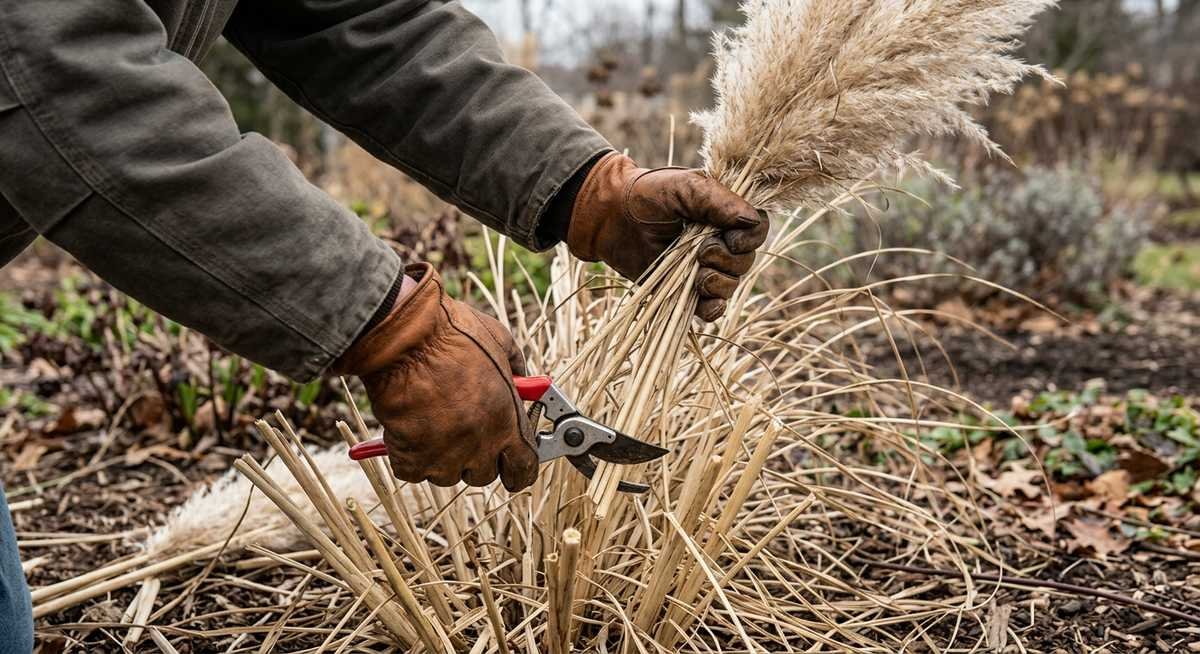
The leaf margins on pampas grass have fine, toothed edges that cut skin as easily as a paper cut, yet far more painfully because of the length of each blade. Experienced gardeners reach for thick leather gloves, long pants, and a long-sleeved shirt before approaching the clump. Safety glasses are also worth wearing; fine leaf fragments can become airborne when cutting. A hedge trimmer or reciprocating saw works well for large clumps; hand pruners alone are tedious and hard on joints.
Some gardeners burn back pampas grass instead of cutting it, a method that removes old material quickly. Only attempt burning with a controlled fire permit where permitted by local ordinance, given the plant’s high flammability. In most suburban settings, cutting is the safer and more practical approach.
Is Pampas Grass Invasive?
Pampas grass is listed as invasive in California, Oregon, Washington, Alabama, South Carolina, Florida, and several other states. Its spread potential is not theoretical. A single plant can produce an estimated 416,000 seeds per season, according to field measurements conducted by the Washington State Noxious Weed Control Board. Seeds are lightweight and wind-dispersed, capable of colonizing roadsides, coastal dunes, wetland margins, and shrublands far from the original planting.
“Mistake for planting pampas grass here?” — that question, posted to r/GardeningUK in March 2026, earned 56 upvotes and dozens of responses from gardeners who had watched a single plant spread well beyond its original footprint.
— r/GardeningUK, March 2026 (56 upvotes)
Before planting standard pampas grass, check with your state’s department of agriculture or local cooperative extension office to confirm it is legal and advisable in your area. In California, the species is listed as a noxious weed by multiple counties and is actively managed along roadsides and coastal habitats. The Washington State Noxious Weed Control Board classified it as a Class C weed in 2015 after discovering an infestation of nearly 500 plants in a single location.
The practical fix for most gardeners in at-risk regions is to choose ‘Pumila’, the sterile dwarf cultivar. It delivers the plume display without the seed production. A single species, roughly 36 inches of ornamental grass, versus 416,000 potential offspring per season — the choice in invasive-risk areas is straightforward.
Common Problems, Pests, and Removal
Pampas grass has remarkably few pest and disease problems under normal growing conditions. Fungal issues can occur in shaded sites with poor air circulation, and aphids occasionally colonize new growth in spring, but neither problem typically requires intervention beyond correcting the underlying growing conditions.
Removal of an established clump is the most common challenge gardeners face. Mature clumps develop dense, fibrous root systems that resist pulling. The Washington State Noxious Weed Control Board recommends using a Pulaski, mattock, or heavy-duty shovel to remove the entire crown and top section of roots to prevent resprouting. For chemical control, consult the PNW Weed Management Handbook or your local county noxious weed coordinator for approved herbicide options, as application timing and product selection vary by region.
When removing pampas grass mechanically, cut and bag any seed heads first, before digging, to prevent spreading seeds during the removal process. Dispose of plant material in sealed bags to the landfill rather than composting it.
Frequently Asked Questions
How fast does pampas grass grow?
Pampas grass typically adds 2 to 4 feet of height per year during its establishment phase. A young plant set out in spring can reach 6 to 8 feet by its second growing season under good conditions. Full mature size of 10 to 13 feet is generally reached by year three or four.
Is pampas grass toxic to dogs or cats?
Pampas grass is considered non-toxic to dogs and cats by the ASPCA. The primary physical risk to pets is from the sharp leaf margins, which can cause cuts to paws, noses, and eyes. Plant it away from areas where pets regularly play or run.
How do I get rid of pampas grass?
Cut the pampas grass plant back to about 6 inches, remove seed heads first, then dig out the entire root crown with a mattock or heavy shovel. Multiple growing seasons of regrowth cutting may be needed for large clumps. Herbicide treatments containing glyphosate are effective when applied to freshly cut stems, though approval varies by region and situation.
Can pampas grass grow in pots?
Pampas grass can be grown in large containers but performs best in the ground. Container plants need a pot at least 18 to 24 inches in diameter, will require regular watering, and are unlikely to achieve the full height or plume size seen in ground-planted specimens. Dwarf ‘Pumila’ is the more practical choice for container growing.
Why isn’t my pampas grass producing plumes?
The most common reasons pampas grass fails to bloom are insufficient sunlight (less than six hours daily), over-fertilization with nitrogen, or a male plant that produces less showy plumes. Young plants established within the last year may also not bloom until their second growing season. Confirm the plant is sited in full sun before investigating other causes.
What are good alternatives to pampas grass in invasive-risk areas?
Several non-invasive ornamental grasses provide similar visual impact. Feather reed grass (Calamagrostis acutiflora ‘Karl Foerster’) grows 4 to 6 feet tall with upright plumes and is hardy to zone 5. Giant feather grass (Stipa gigantea) offers tall, airy flower heads without invasive tendencies. Both are recommended alternatives by the Washington State Noxious Weed Control Board.
How is pampas grass used in floral arrangements?
Dried pampas grass plumes are cut when they are freshly opened in fall, hung upside down in a warm dry space for one to two weeks, and then used in bouquets, wreaths, and home décor. Female plant plumes hold their shape better after drying. Spraying dried plumes lightly with hairspray helps reduce shedding during indoor use.
A Grass Worth Growing, With Eyes Open
Pampas grass earns its reputation as one of the most visually arresting plants in any warm-climate garden. Those plumes, glowing silver in late-afternoon light, explain why the plant has traveled from the South American pampas to gardens on five continents. The care requirements are minimal once you understand the plant’s needs: full sun, reasonable drainage, an annual hard cutback, and respect for its sharp edges.
The invasiveness question is real and worth taking seriously. Sterile cultivars like ‘Pumila’ exist precisely to let gardeners enjoy the visual impact without the ecological risk. For anyone in zones 7 to 10 who can accommodate the scale, few plants deliver as much presence for as little ongoing effort. For more detailed botanical information, the NC State Extension Plant Toolbox maintains a detailed botanical profile of Cortaderia selloana.