
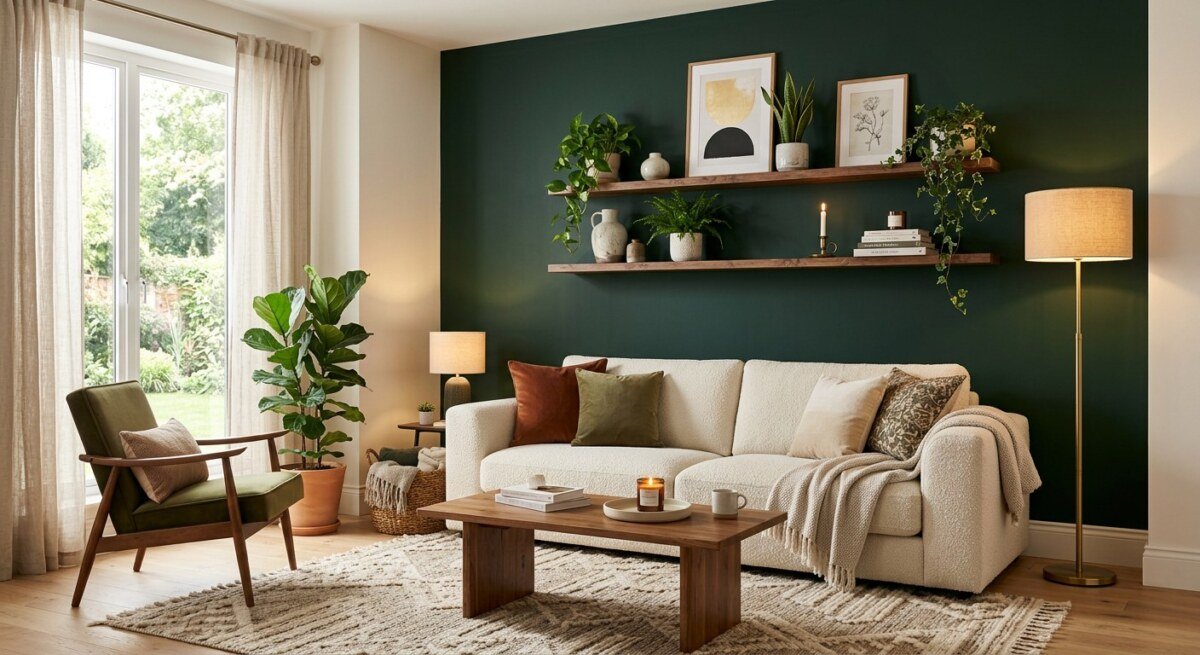
The best accent wall living room ideas do one thing well: they give a room a clear visual anchor. Paint one wall a deep sage green, hang textured wood panels behind the sofa, or lean into bold wallpaper on the fireplace wall — the result is a space that reads intentional rather than accidental. A feature wall costs far less than a full renovation and changes a room in a weekend.
How to Choose the Right Accent Wall in Your Living Room
The best accent wall is the one your eyes land on first when you walk through the door. In most living rooms, that is the wall directly facing the main entrance, the wall behind the sofa, or the wall that holds the fireplace or TV. Pick one of those three and you cannot go far wrong.
Rooms with architectural features (a built-in bookcase, a fireplace surround, a bank of windows) already have a natural focal point. The accent wall should frame that feature, not compete with it.
If the room has no obvious focal point, the wall behind the primary seating area (usually the sofa) is the most reliable choice. It anchors the furniture arrangement and adds depth without making the space feel smaller.
A few practical rules worth keeping:
- Avoid a wall with multiple doorways or windows; too many interruptions break the visual impact
- In rooms under 200 square feet, pick a short wall rather than a long one to avoid closing in the space
- North-facing walls receive cooler light, warmer paint tones compensate, while cool tones like slate blue can feel cold
- Rooms with high ceilings (10 feet or above) can handle darker, bolder choices that would overwhelm a standard-height room
The decision often comes down to function. Most designers advise clients to stand in the doorway and simply notice where their eyes go naturally, that instinct is almost always right.
The Best Accent Wall Styles for Living Rooms
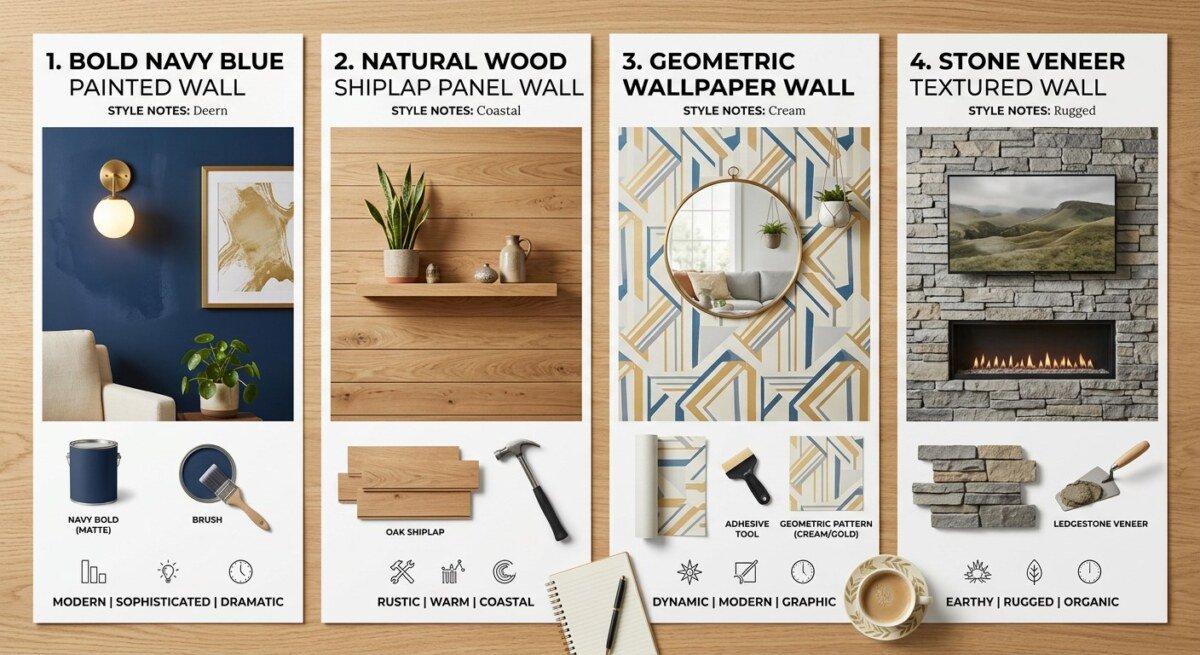
Living room accent walls fall into five broad categories: paint, wallpaper, wood panels, stone or brick, and gallery arrangements. Each creates a different mood and comes with a different price point and installation complexity.
Bold Paint Color
Paint is the fastest, most reversible option and the one that produces the most dramatic return for the least investment. A single quart covers a standard 10×8-foot wall and costs $15–$45.
Deep, saturated colors, forest green, navy, terracotta, charcoal, work well on accent walls precisely because they would feel oppressive on all four walls. Confined to one surface, they read as confident rather than heavy.
For a subtler take, a tone-on-tone approach (painting the accent wall two shades darker than the surrounding walls in the same hue family) adds dimension without the full commitment of a contrasting color.
Wallpaper and Peel-and-Stick Options
Traditional wallpaper on one wall turns a living room into a statement space. Botanical prints, geometric patterns, grasscloth textures, and large-scale murals are all common choices.
Peel-and-stick wallpaper, which has improved significantly in print quality since 2020, removes cleanly and costs roughly half the price of traditional paste-applied versions. It is the standard recommendation for renters or anyone not yet committed to a permanent choice.
Expect to pay $80–$250 for enough wallpaper to cover a standard accent wall, depending on the pattern and brand.
Wood Panels: Shiplap, Slats, and Board and Batten
Wood-paneled accent walls have dominated interior design trends since roughly 2018 and show no sign of fading. The three most popular treatments are shiplap (horizontal tongue-and-groove boards), vertical wood slats (thin strips with gaps between them), and board and batten (wide boards separated by narrow vertical strips).
All three can be painted any color or left as natural wood. Vertical slat walls in a light natural finish have become the default in Scandinavian-influenced interiors; painted white shiplap reads as classic American farmhouse. The same structural technique produces radically different aesthetics depending on finish.
Material cost for a DIY wood panel wall typically runs $150–$500 for the boards alone, plus paint or stain. Professional installation adds $300–$900 depending on complexity.
Stone and Brick Veneer
Faux stone panels and brick veneer (lightweight sheets that adhere directly to drywall) deliver the visual weight of a masonry wall without structural reinforcement. They suit industrial, rustic, or Mediterranean interiors particularly well.
Stone veneer sheets run $6–$15 per square foot, meaning a 120-square-foot wall costs $720–$1,800 in materials, significantly more than paint but comparable to premium wallpaper.
The texture and depth of a stone wall creates a sense of permanence that paint simply cannot replicate. In rooms with high ceilings and exposed beams, it is the kind of choice that makes visitors assume the house was always that way.
Gallery Walls
A well-executed gallery wall uses framed art, mirrors, and objects to create a curated surface that functions as an accent wall without any paint or material change. The wall color stays neutral; the arrangement does the work.
Gallery walls work especially well on walls with architectural limitations (windows, doorways, outlets) where a solid material treatment would be impractical. They are also the most personal option, the arrangement tells a story no paint color can.
Best Colors for Living Room Accent Walls in 2025
Color trends in accent walls have shifted toward earthy, grounded tones over the past two years, moving away from the millennial-pink and cool-gray dominance of the mid-2010s. The most popular living room accent wall colors right now fall into four families.
| Color Family | Best For | Pairs Well With | Mood |
|---|---|---|---|
| Deep Green (sage, forest, olive) | Bright rooms, south/west-facing walls | Natural wood, cream, warm white | Grounded, organic, calm |
| Navy / Deep Blue | High-ceiling rooms, fireplace walls | Brass hardware, white trim, warm neutrals | Sophisticated, bold, classic |
| Terracotta / Clay | Mediterranean, bohemian, earthy schemes | Rattan, linen, warm wood tones | Warm, inviting, sunset-toned |
| Charcoal / Warm Black | Dramatic statements, gallery walls behind | White, blush, metallics, art with color | Dramatic, modern, gallery-ready |
Natural light matters more than almost any other variable. Color theory research confirms that the direction a room faces substantially changes the perceived warmth of a paint color. A north-facing wall in late afternoon reads two or three shades cooler than the same paint in a south-facing space at midday.
For north-facing rooms, warm-undertoned colors (terracotta, warm gray, olive) compensate for the cooler ambient light. South-facing rooms can handle cooler, more saturated colors without them reading as cold.
Accent Wall Cost Comparison by Type
Budget is a practical constraint that most inspiration articles skip over. Here is a straightforward comparison of material and installation costs for a standard 120-square-foot accent wall (approximately 12 feet wide × 10 feet tall).
| Type | DIY Material Cost | Professional Total (Est.) | Reversibility | Weekend DIY? |
|---|---|---|---|---|
| Accent paint color | $15–$60 | $200–$400 | Easy (repaint) | Yes |
| Peel-and-stick wallpaper | $80–$200 | $300–$600 | Easy (peel off) | Yes |
| Traditional wallpaper | $120–$400 | $400–$900 | Moderate (strip) | Possible |
| Wood shiplap / slats | $150–$500 | $500–$1,400 | Hard (remove boards) | With experience |
| Stone / brick veneer | $720–$1,800 | $1,500–$3,000 | Very hard | Not recommended |
Paint is the obvious starting point for anyone uncertain about color, commit only $30, test it for a few months, then consider upgrading to a textured treatment once the color direction is confirmed.
Mistakes That Ruin Living Room Accent Walls
Interior decorating communities on Reddit regularly surface the same errors, walls that looked great in photos but felt off in person. Most trace back to three avoidable decisions.
“Please PLEASE tell me what color to paint our living room” — the kind of post that shows up on r/HomeDecorating every few weeks, usually accompanied by photos of a wall with three doorways and a ceiling vent dead center. The follow-up comment from the room’s owner is almost always the same: the wrong wall was painted first.
— Recurring thread pattern, r/HomeDecorating (a community focused on interior color and furniture selection)
Choosing a wall with too many interruptions, doors, windows, outlets, vents, breaks up the visual impact and turns what should be a bold statement into a fragmented mess. The wall needs uninterrupted surface area to do its job.
Going too dark in a small room is the second most common error. A deep charcoal in a 12×14-foot living room can make the space feel like a cave, particularly if the room has only one window. The fix is not to avoid dark colors entirely, but to test them: paint a 2×4-foot sample board and live with it for 48 hours before committing to the whole wall.
The third mistake is ignoring the existing furniture. An accent wall does not exist in isolation, it is the backdrop to everything already in the room. A terracotta wall behind a red sofa creates visual noise; the same wall behind a neutral linen sectional reads as sophisticated. Pull the dominant color from your largest piece of furniture and work from there.
Most design failures are not about the wall at all. They are about the misalignment between the wall and everything in front of it.
Frequently Asked Questions
Which wall should be the accent wall in a living room?
The wall you look at first when entering the room, typically the one facing the main entrance or the wall behind the sofa, makes the strongest accent wall. Avoid walls broken up by multiple doors or windows. For rooms with a fireplace, that surround wall is the natural choice.
Are accent walls still in style in 2025?
Accent walls remain a current design technique, though the execution has evolved. The all-gray or millennial-pink accent walls of 2015 look dated; textured treatments (wood slats, limewash paint, natural stone) and deeply saturated nature-inspired colors (forest green, warm terracotta, rich navy) are the contemporary standard. The concept of a single feature wall is not going anywhere.
What color should a living room accent wall be?
The most reliable approach is to select a color that already exists in the room, pulled from a rug, cushion, or piece of art, and use it in a deeper or more saturated version on the accent wall. This creates coherence rather than contrast for its own sake. Alternatively, use the color wheel: warm-toned rooms pair well with cooler accent walls (blue-green against warm beige) for a balanced contrast.
How do I create a cheap accent wall in the living room?
Paint is the most cost-effective option: a single quart of quality interior paint covers a standard accent wall for under $40. Peel-and-stick wallpaper is the next step up, costing $80–$200 and removing cleanly. Sourcing reclaimed wood boards from local salvage yards can bring a shiplap wall within the $100 range for materials alone, though it requires more preparation time.
Can you have two accent walls in a living room?
Two accent walls work in specific situations: adjacent walls in a corner arrangement (common in corner fireplace setups), or opposite walls where the treatment visually frames the room rather than competes within it. As a rule, the two walls should use the same treatment or a clearly intentional relationship, two different bold paint colors on opposite walls rarely reads well.
Making the Right Choice for Your Room
The single most useful thing about an accent wall is the permission it gives. Permission to use a color you love but would not risk on four walls. Permission to try a material you have admired in magazines. Permission to change the room without changing the room.
Start with the focal wall. Start with paint if the budget is tight or the commitment uncertain. Choose a color that already lives somewhere in the room. And then paint the sample, live with it for two days, and decide.
The rooms that feel most designed are usually the ones where someone made a single deliberate choice and followed through on it.