
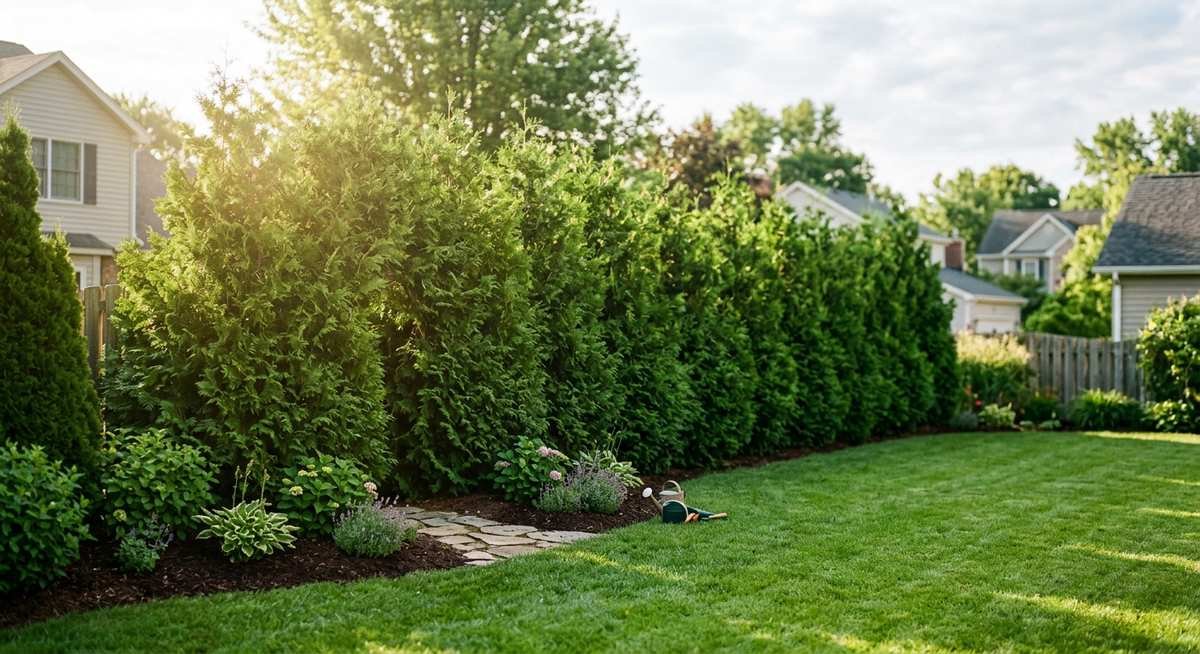
Emerald green arborvitae (Thuja occidentalis ‘Smaragd’) reach 12 to 15 feet tall while staying just 3 to 4 feet wide, making them one of the most reliable privacy hedge options for USDA zones 3 through 7. Getting them established, though, depends almost entirely on what happens during the first 48 hours after planting and the 12 months that follow.
Proper site selection, soil preparation, and a consistent watering schedule during the establishment period separate thriving hedges from rows of brown, struggling trees. With correct spacing and soil amendment, emerald green arborvitae planting success rates climb well above average, though survival depends heavily on consistent watering through the first growing season.
Choosing the Right Spot and Preparing the Soil
Emerald green arborvitae need a minimum of six hours of direct sunlight daily and well-drained soil with a pH between 6.0 and 8.0. Partial shade is tolerable, but hedges planted in full sun grow denser and maintain that signature emerald color year-round.
Start by testing your soil’s drainage. Dig a hole 12 inches deep, fill it with water, and wait. If the water drains within four hours, your site passes. Standing water after eight hours signals a drainage problem that will rot arborvitae roots within the first growing season.
Homeowners on r/landscaping frequently ask about planting near fences, foundations, and utility lines. The safe minimum is 3 feet from any fence line and 4 to 5 feet from a house foundation. Underground pipes and utilities need at least 5 feet of clearance.
“Should I plant a few thuja green giant about 4 feet away from my fence line for privacy or is my yard too small? I was leaning toward emerald green arborvitae, but research is pointing me towards Thuja.”
— r/landscaping, March 2026 (2 upvotes)
For clay-heavy soil, mix in one part coarse compost for every three parts native soil. Sandy soil benefits from adding peat moss at the same ratio to improve moisture retention. The University of Minnesota Extension recommends amending the backfill rather than just the planting hole to prevent a “bathtub effect” where water pools around the root ball.
That drainage test, a simple 12-inch hole filled with water, takes about ten minutes to set up. It might be the cheapest insurance against losing a $40-per-tree investment before the first winter.
When to Plant Emerald Green Arborvitae
Early spring after the last frost and early fall at least six weeks before the ground freezes are the two best planting windows for emerald green arborvitae. Between the two, fall planting often produces stronger root establishment because the tree focuses energy below ground rather than pushing new foliage.
| USDA Zone | Spring Window | Fall Window | Avoid |
|---|---|---|---|
| Zone 3 | Late May to mid-June | Late August to mid-September | June heat, late fall frost |
| Zones 4-5 | Mid-April to late May | September to mid-October | July-August transplant stress |
| Zones 6-7 | March to mid-April | October to early November | Summer drought periods |
Summer planting is possible but risky. Heat stress forces new transplants to lose moisture through their foliage faster than undeveloped roots can replace it. The result is transplant shock, which shows up as browning tips within two to three weeks.
Gardeners eager to get trees in the ground at the first sign of warm weather often overlook that fall-planted arborvitae develop root systems quietly through cool months, then explode with top growth the following spring. The patience of waiting for September pays off in a measurably faster privacy screen by year two.
Step-by-Step Emerald Green Arborvitae Planting Guide
Successful emerald green arborvitae planting takes about 20 to 30 minutes per tree and requires a shovel, garden hose, mulch, and optionally a soil amendment like compost or peat moss. Follow these eight steps for each tree in your hedge row.
- Mark your spacing. Use stakes and a string line to mark each planting position. For a dense privacy hedge, space trees 3 feet apart center-to-center. For a looser screen with better air circulation, go 4 feet apart.
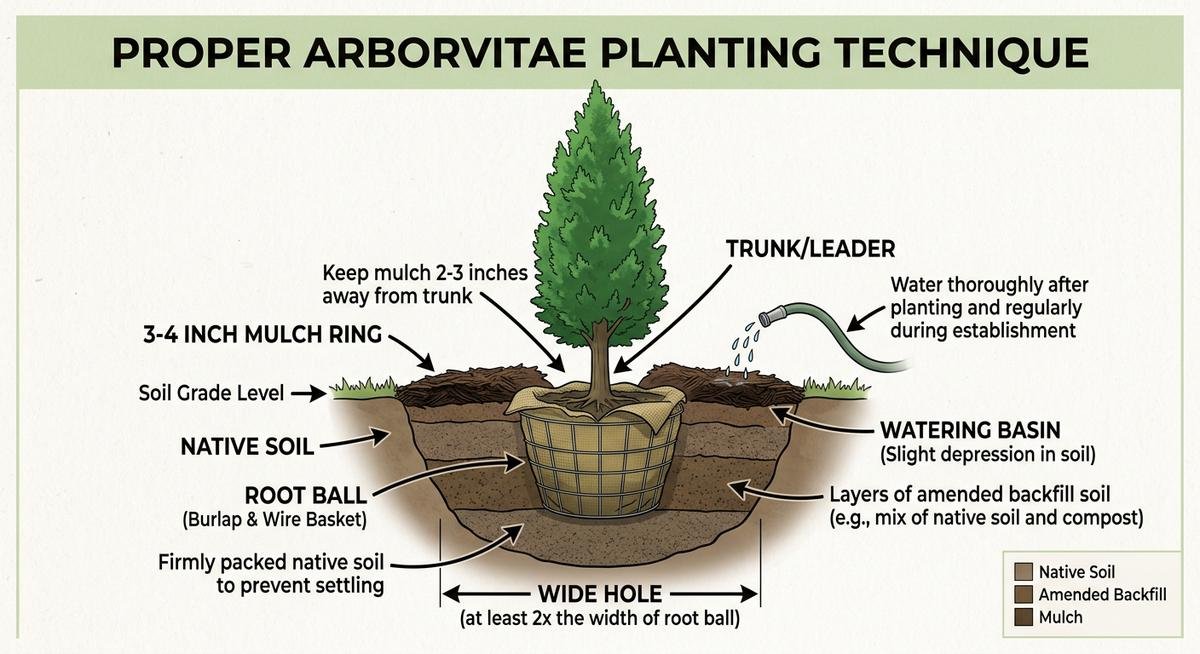
- Dig the hole. Make each hole twice as wide as the root ball and exactly as deep. A hole that is too deep causes the trunk flare to sit below grade, inviting crown rot.
- Check drainage. Pour a gallon of water into the empty hole. If it does not drain within 15 minutes, add 4 inches of gravel at the bottom or choose a different location.
- Remove the tree from its container. Gently slide the root ball out. If roots are circling the outside, score them with a knife in four vertical cuts to encourage outward growth.
- Set the root ball at grade level. The top of the root ball should sit even with the surrounding soil surface. Never bury the trunk flare.
- Backfill with amended soil. Mix native soil with compost at a 3:1 ratio. Tamp lightly every 6 inches to eliminate air pockets. Do not pack the soil tightly.
- Create a watering basin. Build a 3-inch soil berm in a ring around the outer edge of the planting hole. This directs water straight to the root zone.
- Apply mulch. Spread 3 to 4 inches of shredded bark or pine mulch in a ring around the tree, keeping mulch 3 inches away from the trunk to prevent moisture damage to the bark.
| Spacing | Trees per 50 ft | Years to Full Privacy | Approx. Cost (at $35-50/tree) |
|---|---|---|---|
| 3 feet apart | 17 trees | 3-4 years | $595-$850 |
| 4 feet apart | 13 trees | 5-6 years | $455-$650 |
| 5 feet apart | 10 trees | 7-8 years | $350-$500 |
“Can’t decide between emerald green or green giant arborvitae for privacy wall.”
— r/landscaping, April 2026
This is one of the most common debates across landscaping communities. Emerald greens top out at 12 to 15 feet with a narrow 3 to 4 foot spread, making them ideal for tight spaces and suburban lots. Green giants reach 40 to 60 feet with a 12 to 20 foot spread. For a property line hedge under 15 feet, emerald green is almost always the right pick.
First-Year Watering and Establishment Care
Newly planted emerald green arborvitae need deep watering two to three times per week for the first six weeks, then once per week through the remainder of the first growing season. Each watering session should deliver roughly 1 to 1.5 gallons per foot of tree height.
The first six weeks after planting are the most critical period for root establishment. Roots have not yet grown beyond the original root ball, so the tree depends entirely on consistent moisture delivered directly to that zone.
“We planted these emerald green arborvitae last fall and they’re not doing good with the dry spring. I run a soaker hose 60 min each day but doesn’t seem to be doing much. Any advice?”
— r/arborists, 2025 (community discussion)
This aligns with guidance from the Morton Arboretum, which confirms that shallow daily watering is less effective than deep soaking two to three times weekly. Soaker hoses work well, but they need to run long enough for water to penetrate 8 to 10 inches into the soil.
| Period | Watering Frequency | Amount per Tree | Key Indicator |
|---|---|---|---|
| Weeks 1-6 | 2-3 times/week | 5-8 gallons | Soil moist 6 inches deep |
| Weeks 7-12 | Once/week | 5-8 gallons | Top 2 inches dry between waterings |
| Months 4-12 | Once/week (rain supplement) | 3-5 gallons | Natural rainfall fills most needs |
| First winter | Once/month if no snow cover | 3 gallons | Ground not frozen |
Hold off on fertilizing until the second growing season. Fertilizer applied to newly planted trees pushes top growth that the underdeveloped root system cannot support. The result looks like healthy green tips on branches that suddenly brown and die back in midsummer heat.
So many first-year emerald greens turn brown despite daily watering from well-intentioned homeowners. The counterintuitive reality is that frequent shallow watering keeps roots near the surface where they are vulnerable to heat and drought. Less frequent, deeper soaking trains roots downward into cooler, more stable soil layers.
Common Planting Mistakes and How to Fix Them
Five errors account for roughly 80% of emerald green arborvitae planting failures in the first year: planting too deep, underwatering during establishment, wrong spacing, poor drainage, and volcano mulching. Each one is preventable.
| Mistake | Symptom | Fix |
|---|---|---|
| Planting too deep | Trunk flare buried, lower foliage browns first | Carefully excavate soil to expose root flare, re-grade |
| Insufficient watering | Tips brown, foliage crispy from top down | Deep soak 2-3x/week for 6 weeks, check soil moisture at 6 inches |
| Too-close spacing (<2.5 ft) | Inner branches die from lack of light, fungal issues | Cannot fix easily; plan removal of alternating trees long-term |
| No drainage check | Entire tree yellows, root rot smell at base | Dig up, improve drainage with gravel bed, replant higher |
| Volcano mulching | Bark decay at trunk base, pest entry points | Pull mulch back 3 inches from trunk, reshape to flat ring |
“I planted these Emerald Green Arborvitae a few months back and now they are browning from the inside out. Are they dying? What can I do to save them?”
— r/arborists, community discussion (13 comments)
Arborists in that thread pointed out that interior browning is often normal seasonal shedding of older foliage, not a death sentence. The key distinction: browning that starts at the tips and works inward signals stress or disease, while browning on interior branches close to the trunk is natural needle drop that happens every fall.
According to Purdue University Extension, transplant shock affects up to 30% of container-grown arborvitae in the first season and typically resolves within 8 to 12 weeks if watering is adequate. The difference between a tree that recovers and one that does not almost always comes down to root ball moisture during those initial weeks.
Frequently Asked Questions
How far apart should I plant emerald green arborvitae?
Space emerald green arborvitae 3 feet apart for a dense privacy hedge or 4 feet apart for a looser screen with better air circulation. Spacing tighter than 2.5 feet causes interior dieback from lack of sunlight and increases fungal disease risk.
What is the best time of year to plant emerald green arborvitae?
Early spring after the last frost and early fall at least six weeks before ground freeze are the best planting times. Fall planting gives roots a head start before winter dormancy, often producing faster top growth the following spring compared to spring-planted trees.
How deep should I plant emerald green arborvitae?
Plant so the top of the root ball sits exactly level with the surrounding soil surface. The trunk flare where roots begin to spread should be visible above grade. Planting even 2 inches too deep can lead to crown rot and slow decline.
How much water do newly planted emerald green arborvitae need?
New transplants need 5 to 8 gallons of water delivered two to three times per week for the first six weeks. After that, taper to once per week through the first growing season. Deep soaking is more effective than frequent light watering.
Can you plant emerald green arborvitae in shade?
Emerald green arborvitae tolerate partial shade with four hours of direct sun, but hedges planted in full sun (six or more hours daily) grow significantly denser. Deep shade results in thin, sparse growth that defeats the purpose of a privacy screen.
How long does it take emerald green arborvitae to grow to full size?
Emerald green arborvitae grow 6 to 9 inches per year under good conditions and reach their mature height of 12 to 15 feet in 10 to 15 years, according to the USDA Plants Database profile for Thuja occidentalis. Growth rate depends heavily on watering, soil quality, and sun exposure during the first three years.
What is the difference between emerald green and green giant arborvitae?
Emerald green (Thuja occidentalis ‘Smaragd’) reaches 12 to 15 feet tall and 3 to 4 feet wide, ideal for suburban lots. Green giant (Thuja standishii x plicata) grows to 40 to 60 feet with a 12 to 20 foot spread, suited for large rural properties needing fast, tall screening.
How do I know if my newly planted arborvitae is dying?
Browning from the tips inward, brittle branches that snap instead of bending, and a lack of any new growth after 8 weeks are warning signs. Interior browning near the trunk, by contrast, is normal seasonal needle drop. Scratch a small section of bark on a suspect branch: green underneath means the tree is still alive.
Getting Your Emerald Green Arborvitae Hedge Off to a Strong Start
Three things determine whether your emerald green arborvitae planting succeeds or fails: proper site preparation with tested drainage, correct planting depth with the root flare at grade, and consistent deep watering through the first growing season. Skip any one of these and the odds shift against you.
Start with a soil drainage test before you buy a single tree. Choose your spacing based on how quickly you need full privacy. Then commit to the watering schedule for those first critical six weeks. By the second spring, a well-planted emerald green arborvitae hedge fills in quickly enough that the effort pays for itself in privacy and property value.