

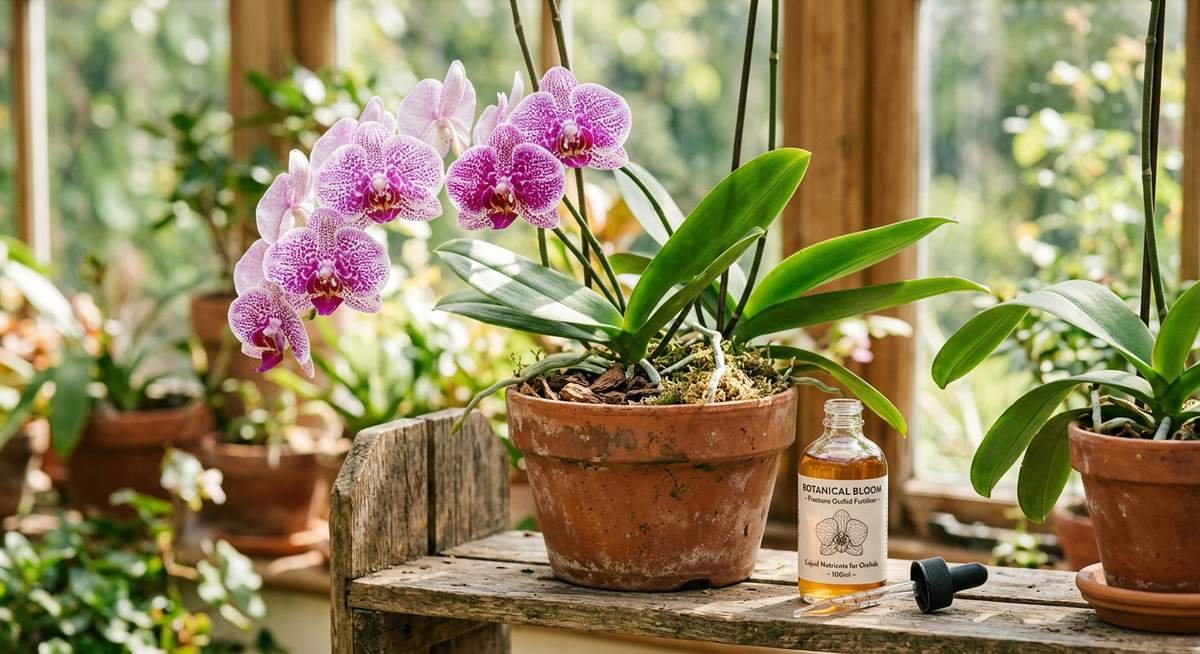
Getting the right fertilizer for orchid plants is less about finding the perfect product and more about understanding how little these flowers actually need. Orchids evolved on bare tree bark and rocky cliffs in tropical forests, pulling nutrition from rain and windblown debris, which means their threshold for “too much” arrives far sooner than most growers expect.
A balanced water-soluble fertilizer orchids plants respond to best is applied at quarter strength, once a week during active growth. That’s the short answer. The long answer involves understanding what each nutrient actually does, when to pull back, and why your water source matters more than the brand you choose.
What Fertilizer Orchids Plants Actually Need: The Basics
Fertilizer is not plant food. The energy that plants run on comes from light and photosynthesis. Fertilizer is closer to a multivitamin: it supplies the mineral building blocks that plants cannot manufacture themselves. For orchids specifically, those minerals are needed in unusually small doses.
Orchids are epiphytes by nature. In the wild, most Phalaenopsis, Cattleya, and Dendrobium species grow attached to tree bark, not buried in soil. Their roots wrap around branches and absorb nutrients from passing rainfall and decomposing organic matter. According to the American Orchid Society (AOS), the main nutrient inputs for wild epiphytic orchids are rainwater and small amounts of tree debris falling from higher branches, neither of which provides the nutritional density of potting soil. Orchids have, over millions of years, tuned their metabolisms to thrive on near-starvation rations.
That evolutionary history has a practical consequence for growers: fertilizer burn shows up faster with orchids than with most other plants. Potassium, in particular, accumulates in orchid tissue because orchids have developed a tendency to hyperaccumulate it when it becomes available. When potassium levels tip over the threshold, leaf tips turn black. Many growers mistake this for fungal disease, and it does look nearly identical. The diagnostic clue is timing: if the blackening appeared after a fertilizer application, it’s salt burn. If new growth is unaffected, it’s almost certainly fertilizer burn.
The nutrients orchids require fall into two categories. Macronutrients (nitrogen, phosphorus, potassium, calcium, magnesium, and sulfur) are consumed in the largest quantities. Micronutrients (boron, iron, zinc, copper) are needed only in trace amounts but are essential for enzyme function and photosynthesis. A complete orchid fertilizer addresses all of these, though the ratios that matter most shift depending on the time of year.
Choosing the Right Fertilizer for Orchid Plants: NPK Ratios Explained
The three numbers on every fertilizer label represent nitrogen (N), phosphorus (P), and potassium (K), in that order. A 20-20-20 fertilizer contains equal percentages of each by weight. For orchids, those equal ratios are a reasonable starting point, but understanding what each nutrient does lets you make better decisions as seasons change.
Nitrogen drives vegetative growth: new leaves, root tips, and pseudobulb development. Phosphorus supports cell division and is essential for flower spike initiation. Potassium regulates water movement and strengthens cell walls. The classic orchid community rule, “feed weakly, weekly,” exists partly because you want to supply all three nutrients consistently without allowing potassium to accumulate to toxic levels.
| Fertilizer Type | NPK Example | Best For | Pros | Cons |
|---|---|---|---|---|
| Balanced liquid | 20-20-20 | Year-round general use | Fast absorption, easy dosing | Must dilute carefully; flushes out quickly |
| Bloom-booster liquid | 10-30-20 | Pre-blooming trigger (fall) | Promotes flower spike development | Not for vegetative growth phase |
| High-nitrogen liquid | 30-10-10 | Active growth season (spring/summer) | Accelerates new root and leaf growth | Can push foliage at expense of blooms if overused |
| Slow-release pellets | 14-14-14 | Low-maintenance growers | No weekly measuring | Salt accumulation risk; hard to control dosage |
| Organic (fish emulsion) | 5-1-1 | Natural-growing advocates | Low burn risk, adds trace minerals | Odor; variable NPK from batch to batch |
One important distinction on labels: urea-free fertilizers are generally preferred for orchids. A 2017 review published in HortTechnology (Wang & Chang) found that the form of nitrogen, not just the total amount, significantly affects Phalaenopsis growth and flowering. Urea requires soil bacteria to convert it into a plant-available form. Orchids grown in bark or moss media have far fewer bacteria than garden soil, so urea-based nitrogen may pass through largely unused. Look for fertilizers where nitrogen comes from nitrate or ammonium sources instead.
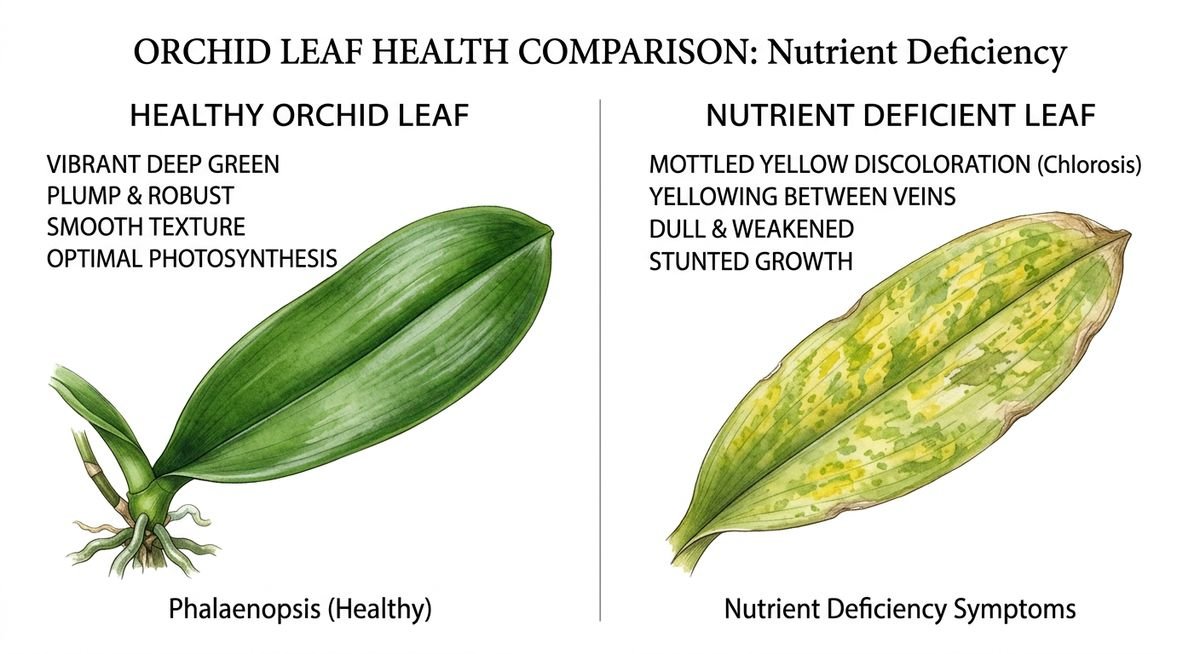
A note on calcium and magnesium: these two elements compete for the same uptake sites in roots. If you run a high-calcium water supply and a low-magnesium fertilizer, your orchids may develop interveinal chlorosis, a mottled, watercolor-looking discoloration of leaves that is sometimes mistaken for viral infection. Balance matters more than absolute quantity.
How to Apply Fertilizer to Orchid Plants: Step-by-Step
Correct application technique prevents the most common fertilizer problems before they start. The approach differs slightly depending on whether your orchid is potted in bark, moss, or hydroponics, but the core principles hold across all media types.
- Water thoroughly first. Never apply fertilizer to a dry root system. Dry roots absorb fertilizer salts in concentrated form, which causes tip burn. Water the orchid until liquid flows from drainage holes, then wait 30 minutes before fertilizing.
- Mix at quarter to half the label rate. Most fertilizer labels are calibrated for high-feeding plants like tomatoes. Orchids respond better to dilute, frequent applications. Quarter strength (one-quarter of the recommended dose) applied weekly is the AOS-endorsed approach for most hobbyists.
- Apply to the roots, not the crown. Pour the diluted fertilizer directly into the potting medium. Fertilizer pooling in the crown of Phalaenopsis or the leaf sheaths of Cattleya invites rot, particularly in low-humidity environments.
- Flush monthly with plain water. Regardless of your water quality, run plain water through the potting medium once per month to leach accumulated mineral salts. Hard water growers should flush every two weeks.
- Skip fertilizer for two to four weeks after repotting. Freshly repotted roots need time to establish contact with new media. Fertilizer salt on exposed root tips delays that process.
“MSU fertilizer is popular here. It’s urea-free and formulated specifically for rain or RO water users — the Ca and Mg ratios are designed to compensate for what’s absent in ultra-pure water.”
— r/orchids, March 2024
This aligns with guidance from the American Orchid Society, which recommends urea-free formulas for growers using reverse osmosis or low-TDS water sources, since those water types lack the calcium and magnesium naturally present in harder tap water.
Orchid Fertilizer Schedule: When and How Often to Feed Orchid Plants
Orchid fertilizing is not a year-round constant. Most orchids cycle through a vegetative growth phase and a rest or blooming phase, and those phases call for different nutrient profiles and frequencies.
| Season | Phase | Fertilizer Type | Frequency | Notes |
|---|---|---|---|---|
| Spring (Mar–May) | Active growth | High-nitrogen (30-10-10) or balanced | Weekly at ¼ strength | New roots and leaves emerging |
| Summer (Jun–Aug) | Peak growth | Balanced (20-20-20) | Weekly at ¼ strength | Highest fertilizer demand of the year |
| Fall (Sep–Nov) | Bloom trigger | Bloom-booster (10-30-20) | Every 2 weeks | Reduce nitrogen; cooler nights signal blooming |
| Winter (Dec–Feb) | Rest period | Very dilute balanced or none | Monthly or pause entirely | Flush once a month; no new growth needs feeding |
Phalaenopsis orchids (moth orchids), which are the most common type found in garden centers and grocery stores, initiate flower spikes in response to a temperature drop of roughly 10°F (5–6°C) at night. Withholding high-nitrogen fertilizer during fall and switching to a bloom-booster formula reinforces that hormonal signal. Growers who continue heavy nitrogen feeding through fall often report good foliage and no blooms — the nitrogen keeps the plant in vegetative mode.
Cattleya orchids follow a slightly different rhythm tied to their pseudobulb development cycle. Feed heavily when new growth is pushing, then back off once the pseudobulb matures and a sheath appears. Dendrobiums vary by species: evergreen types can be fed year-round at reduced rates, while deciduous types require a dry, fertilizer-free winter rest to trigger blooming.
Fertilizer Burn in Orchid Plants: Identification, Prevention, and Recovery
Fertilizer burn is the most common damage caused by over-fertilizing orchids, and it happens faster with orchids than with most houseplants precisely because their root systems were never designed for nutrient-dense environments. Black leaf tips are the signature symptom: the tips turn black, then the blackening may creep inward along the leaf margin.
The underlying mechanism is potassium toxicity. Orchids hyperaccumulate potassium when it becomes available, so even moderate over-fertilizing can push potassium to harmful levels in orchid tissue. The AOS notes that fertilizer burn in orchids predominantly looks like potassium burn, which is important because some fungi and bacterial pathogens produce identical black-tip symptoms. The diagnostic test: examine new growth. If the newest leaves and root tips are unaffected, the damage is almost certainly salt burn, not disease.
Prevention checklist:
- Always dilute to quarter strength or less for Phalaenopsis; half strength is the absolute maximum for vigorous growers like Cattleya
- Never skip the pre-watering step before fertilizing
- Flush the potting medium monthly regardless of visible salt deposits
- Check TDS in your tap water; readings above 525 ppm require extra flushing or filtered water
- Remove any white crust from the surface of bark or moss, which indicates salt accumulation
Recovery protocol: If burn is caught early, flush the pot three times in succession with plain room-temperature water. Let the medium dry slightly between flushes, then resume fertilizing at half your previous dilution rate. Trim damaged leaf tips with sterile scissors and dust cuts with cinnamon (a natural antifungal). Roots showing brown, mushy tips from salt burn can be trimmed back to healthy green-white tissue. The plant will typically stabilize within four to six weeks.
Water Quality and Orchid Fertilizing
The water you use is almost as important as the fertilizer you choose. Hard water, high in dissolved calcium and magnesium, continuously deposits mineral salts in your potting medium even before you add fertilizer. By the time fertilizer salts join the mix, the cumulative TDS in the medium can cross into damaging territory surprisingly fast.
According to the American Orchid Society, water with under 525 parts per million (ppm) of total dissolved solids is tolerable for most orchids, while water below 175 ppm closely mimics orchid-native rainwater and is ideal. For reference, many municipal water supplies across the United States fall between 200 and 500 ppm, though regions drawing from deep aquifers can exceed 600 ppm.
| Water Type | Typical TDS Range | Orchid Suitability | Action Required |
|---|---|---|---|
| Rainwater / distilled | 0–50 ppm | Excellent | Supplement Ca/Mg via fertilizer (MSU formula recommended) |
| Reverse osmosis | 5–25 ppm | Excellent | Same as rainwater; use Ca/Mg-inclusive fertilizer |
| Soft tap water | 50–175 ppm | Good | Standard fertilizing protocol |
| Moderate tap water | 175–525 ppm | Acceptable | Flush every 2 weeks; reduce fertilizer frequency in summer |
| Hard tap water | 525+ ppm | Marginal | Switch to RO or rainwater, or flush weekly |
One common mistake involves water softeners. Ion-exchange softeners replace calcium and magnesium with sodium, and sodium kills orchid roots quickly. Water that has passed through a standard household water softener should never be used on orchids. RO water or a dedicated outdoor tap that bypasses the softener are the practical alternatives.
Frequently Asked Questions: Fertilizer for Orchid Plants
How often should I apply fertilizer to orchid plants?
The best fertilizer for orchid plants is applied once a week during active growth (spring and summer) at quarter-strength concentration, then reduced to every two to four weeks during fall and winter. The “weakly, weekly” approach endorsed by the American Orchid Society prevents salt accumulation while supplying a steady nutrient supply.
What NPK ratio is best in a fertilizer for orchid plants?
A balanced 20-20-20 water-soluble fertilizer works well for year-round general use. During active growth, a higher-nitrogen formula (30-10-10) accelerates root and leaf production. In late summer and fall, switch to a bloom-booster (10-30-20) to trigger flower spike development. Urea-free formulas are preferred in all phases.
Can I use regular plant fertilizer on orchids?
Yes, but dilute it significantly. Standard houseplant fertilizers formulated for heavy feeders like pothos or peace lilies are typically applied at full strength. For orchids, use the same fertilizer at one-quarter to one-half of the label rate to avoid salt burn. Urea-based nitrogen in some formulas is less effective for orchids in bark media, since bark supports fewer soil bacteria for conversion.
Why are my orchid leaf tips turning black after fertilizing?
Black leaf tips after fertilizing almost always indicate fertilizer burn from potassium or salt accumulation. Orchids hyperaccumulate potassium when it becomes available in their root zone, and excessive levels cause tip necrosis. Flush the pot three times with plain water, resume fertilizing at half your previous dose, and trim damaged tips with sterilized scissors.
Do orchids need fertilizer when they are not blooming?
Yes. The period between blooms is when orchids build the energy reserves needed for the next flowering cycle. Continue balanced fertilizing through the non-blooming growth phase. Reduce frequency but do not stop entirely during winter dormancy, particularly for Phalaenopsis, which maintain some root activity year-round.
Should I fertilize orchids growing in water culture?
Orchids in semi-hydro or full water culture (hydroponics) need fertilizer at even lower concentrations, typically one-eighth to one-quarter of the label rate. Change the water and fertilizer solution weekly to prevent stale water and bacterial buildup. Use calcium-nitrate-based fertilizers rather than urea-based ones, since there is no soil bacteria to process urea.
Are coffee grounds or other organic fertilizers good for orchids?
Coffee grounds are not recommended for most orchid media. They can compact bark and promote fungal growth, and their nutrient contribution is minimal compared to their potential to interfere with drainage. Fish emulsion (5-1-1) is the most practical organic option for orchids: it provides available nitrogen and trace minerals with low burn risk, though the odor is significant when applied indoors.
How do I know if my orchid has a nutrient deficiency?
Deficiency location on the plant is the key diagnostic. Mobile nutrients (nitrogen, phosphorus, potassium) show deficiency in older leaves first, because the plant breaks down older tissue to redistribute nutrients to new growth. Immobile nutrients (calcium, boron) show deficiency in new growth, since the plant cannot harvest them from older tissue. Nitrogen deficiency appears as uniform yellowing of older leaves; calcium deficiency causes black death of new growth tips; magnesium deficiency produces a mottled, interveinal chlorosis sometimes confused with viral infection.
Keeping Orchids Fed Without Overdoing It
The right fertilizer for orchid plants is less about the label and more about the dose. Their entire evolutionary history is a story of thriving on almost nothing, adapting to catch nutrients in the brief windows when rainwater delivers them. Matching that natural rhythm is straightforward once you stop applying houseplant logic to an epiphyte. Dilute more than you think you need to. Flush the medium regularly. Adjust the formula with the seasons. The growers who struggle most with fertilizer for orchids plants care are usually the ones giving too much rather than too little.