
Last July, I walked out to check on my tomato plants and stepped right next to a yellowjacket ground nest I didn’t know was there. Three stings on my ankle before I even understood what was happening. I limped back inside, iced the swelling, and spent the next two hours researching everything I could about getting rid of wasps in backyards.
That was my crash course. Since then, I’ve dealt with paper wasps under my patio umbrella, a yellowjacket colony in the retaining wall, and red wasps building inside my shed door frame. Each situation needed a completely different approach — and the stuff that worked on one species was useless on another. I’m far from alone:
“Once I realized what was going on I threw my weed eater and ran. When I returned 9 hours later, the weed eater was still swarmed.” Top comment: “It belongs to them now.”
— r/pestcontrol, July 2023 (615 upvotes) — a community where licensed exterminators and homeowners troubleshoot pest problems together
Here’s what I’ve learned: successful wasp removal comes down to three things — identifying the species, matching the removal method to the nest location, and knowing when to call a professional instead of playing hero. Get any of those wrong, and you’re in trouble. According to the National Pest Management Association, roughly 225,000 Americans end up in emergency rooms from stinging insect encounters each year.
Paper wasps tucked under a patio umbrella need a different approach than yellowjackets tunneling underground near your garden bed. Ground hornets in your yard require dust insecticide, not the aerosol spray that works on aerial nests. I’ll walk you through every common scenario so you can match the right solution to what you’re actually dealing with.
Identify the Wasps Before You Act
This is where most people screw up, myself included. My first instinct with that ground nest was to grab a can of Raid from the garage and blast it. That would have been a disaster — aerosol spray on an underground yellowjacket nest just makes 4,000 angry wasps scatter across your yard instead of staying in one place.
Spend two minutes on identification before you do anything else. The species determines everything — the product, the timing, and whether you should even attempt it yourself.
Yellowjackets, Paper Wasps, and Hornets at a Glance
Three species cause the vast majority of backyard wasp problems across North America. Here’s how to tell them apart:
| Species | Appearance | Nest Style | Aggression | Colony Size |
|---|---|---|---|---|
| Yellowjacket | Compact, bright yellow-and-black, smooth | Underground burrows, wall voids | Very high — pursues threats 50+ feet | 1,000-5,000+ |
| Paper wasp | Slender, long-legged, brownish-yellow | Open umbrella combs under eaves, railings | Moderate — stings when nest is disturbed | 20-200 |
| Bald-faced hornet | Large, black with white face markings | Enclosed gray football-shaped nests in trees | Extremely high — defends a 3-foot perimeter | 400-700 |
| Red wasp | Reddish-brown, similar to paper wasp | Small open combs on porches, fences | Moderate to high | 50-200 |
| Ground hornet (cicada killer) | Large, black-and-yellow, solitary | Individual burrows in garden soil | Low — solitary, rarely stings | Solitary |
Here’s a distinction that matters more than most people realize: ground hornets (cicada killers) are not yellowjackets. They’re solitary wasps that dig individual holes in sandy garden soil, and they’re actually beneficial predators. According to University of Minnesota Extension entomologists, solitary ground-nesting wasps like cicada killers generally don’t warrant removal at all.
I made this mistake my first summer — spent $40 on insecticide treating cicada killer burrows near my raised beds. Turns out they were doing me a favor by eating the insects that damage gardens. Now I leave them alone.
How to Remove Wasp Nests by Location
Nest location determines your entire removal strategy. A paper wasp nest on a deck railing is a 10-minute fix. A colony inside a wall cavity can require professional foam injection and structural assessment. Always treat at dusk or after dark when the full colony is inside and wasps are sluggish from cooler temperatures.
Aerial Nests: Eaves, Light Fixtures, Patio Umbrellas
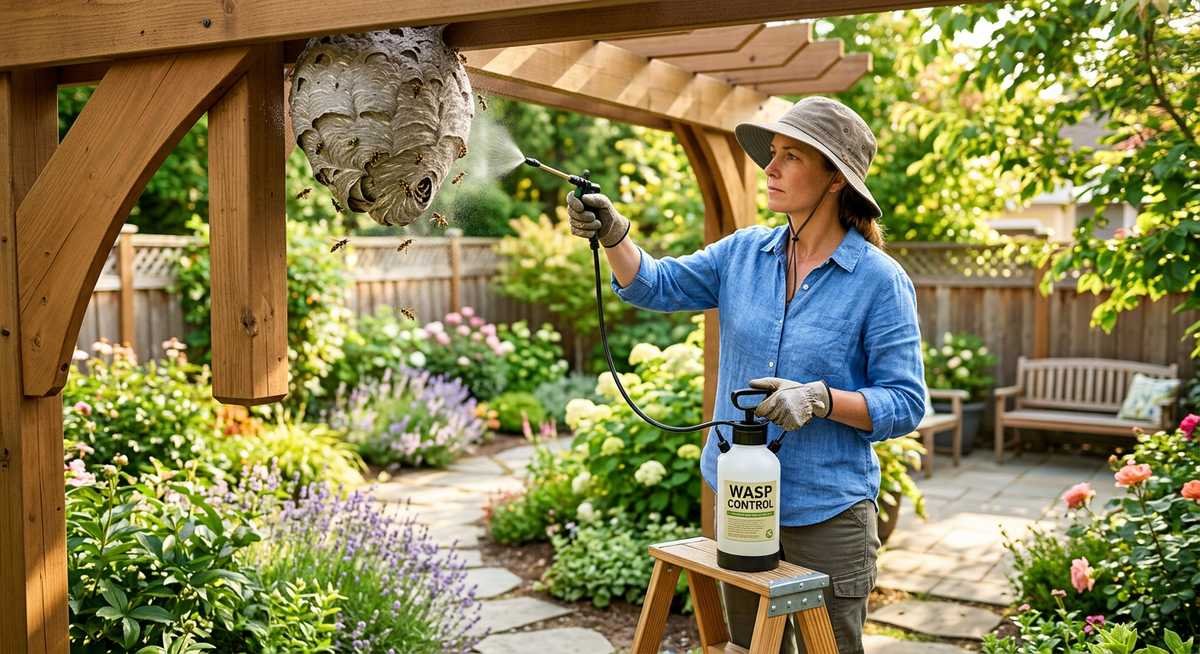
Paper wasps and red wasps build their open-comb nests in sheltered spots — under eaves, inside outdoor light fixtures, on ceiling fan housings, and inside patio umbrella poles. These are the easiest to handle yourself because you can see the entire colony.
Wait at least 30 minutes after sunset. Use a jet-stream aerosol wasp spray rated for 20-foot reach — Spectracide or Raid Wasp & Hornet Killer both run $6-$12 at any hardware store. Stand upwind, aim at the nest entrance, and spray for a full 10-15 seconds until saturated. Wear long sleeves, fitted gloves, and safety glasses.
For a more serious product, u/atlgeo on r/pestcontrol recommended BASF PF Wasp Freeze 2:
As u/atlgeo, r/pestcontrol — a product that costs more than Raid but gets the job done on larger nests: “Just killed a large bald-faced hornet’s nest. Sprayed just before dawn. Into the hole from 10 feet away. Not one hornet escaped the nest.”
As u/VeryStab1eGenius, r/HomeImprovement (15 upvotes) — practical advice from someone who dealt with 8 wasp nests on their deck: “Make sure the evening you decide to spray there isn’t a strong wind. I’d also wear goggles and even a mask. No matter what it says on the can I wouldn’t count on that spray going more than 12 feet.”
Leave the nest untouched for 24 hours, then knock it down with a long stick and seal it in a garbage bag. Check hollow patio umbrella poles and outdoor furniture legs at the start of each season — paper wasps love these enclosed tubes as early-spring nesting sites.
As u/eds68_, r/HomeImprovement (24 upvotes) — overkill? Maybe. But nobody got stung.: “I once put on a rain coat, rain pants, winter gloves under rubber gloves, a wide brimmed hat with mesh over it and then I duct taped all the seams. Fuckers couldn’t get anywhere near me. I was pretty warm by the end but I got em.”
Ground Nests and Underground Yellowjacket Colonies
Underground yellowjacket colonies are the most dangerous backyard wasp situation, and the one most often handled incorrectly. A mature colony packs thousands of workers into a tunnel network that can extend three feet below the surface. Disturbing the entrance during daylight triggers an immediate coordinated attack. The CDC reports that yellowjackets cause more serious sting reactions than any other North American insect.
Here’s my method, refined after dealing with two ground nests in three years:
- Before dark, mark the entrance hole with a ring of flour or a small stake so you can find it without a bright flashlight
- After sunset, apply a dust insecticide — Delta Dust or Tempo Dust — directly into the entrance using a hand duster
- The dust penetrates deep into the tunnel system and clings to wasps as they move, spreading throughout the colony over 24-48 hours
- Do not seal the entrance until you confirm zero activity after 48 hours
“Spray the hive entry point with Alpine WSG for 10 seconds. Repeat the next day if still active… Whatever you decide, do not seal the entry point with foam or anything else until the hive is dead.”
— u/PCDuranet, r/pestcontrol, November 2022 (115 upvotes, 279 comments) — a verified pest control professional’s pinned yellowjacket control guide
Alpine WSG is a professional-grade residual spray; for homeowners, Delta Dust or Tempo Dust applied with a hand duster is more practical and just as effective.
As u/icanbreakthesetarget, r/pestcontrol (28 upvotes): “Tempo or Drione dust. One good pump in the hole, they’ll be gone in 24 hours. It will cause them to swarm the area for a few hours so watch out.”
As u/chubbysumo, r/HomeImprovement (23 upvotes) — the kind of colony that absolutely requires professional help: “We have a massive ground nest in the woods behind our house… it’s at least 4 feet across and has around 20 entrances in the ground. They are angry too.”
Chemical-free alternative for smaller ground nests: Pour a full kettle of boiling water directly into the entrance hole immediately after removing it from heat. Repeat for two or three consecutive nights. This works best on newly established spring colonies before the population explodes in midsummer.
As u/SherrifOfNothingtown, r/HomeImprovement (64 upvotes): “Ground-dwelling wasps can be similarly wrecked by pouring a few gallons of boiling, soapy water down their hole.”
Wall Voids, Garden Sheds, and Outdoor Furniture
A wasp nest inside a wall cavity is almost always a job for a licensed exterminator. I learned this the hard way when I found yellowjackets going in and out of a gap in my shed siding. My instinct was to spray and seal. Bad idea — a colony under pressure will chew through interior drywall or paneling to escape, relocating the problem directly into your living space.
As u/blinden, r/HomeImprovement — what happens when wall void colonies aren’t handled properly from the start: “I called an exterminator, today is his FIFTH visit trying to treat them… They are actually getting INTO my finished basement now.”
Professional wall void treatment typically costs $150-$400 depending on access difficulty and colony size. If professional help isn’t immediately available, injection-style insecticide foam (Stryker Wasp and Hornet Foam or Ortho Home Defense Foam, $10-$18) applied through the exterior entry point can suppress the colony temporarily. Do not seal the entry hole until at least 48 hours after treatment.
For small paper wasp combs on chair legs, garden bed timbers, or under patio decking — a direct soap-and-water spray at night handles them easily. Check hollow fence posts, umbrella poles, and stacked garden pots every spring.
Natural and Non-Lethal Methods
Not everyone wants to nuke every wasp they see, and honestly, that’s the right instinct in a lot of cases. These approaches work best as prevention and perimeter defense. They won’t collapse an active nest, but they can keep wasps away from dining areas, garden beds, and outdoor seating.
Vinegar and Essential Oil Repellents
A vinegar-based trap genuinely reduces forager activity around patios. Here’s how to build one that actually works:
- Cut the top third off a clean 2-liter plastic bottle
- Pour in 1 cup apple cider vinegar, 1/4 cup white sugar, and 1 teaspoon dish soap (the soap breaks surface tension so wasps sink instead of escaping)
- Invert the cut top into the bottle as a funnel, tape the seam
- Hang the trap at least 10 feet from seating areas — placing it too close draws wasps toward people, not away
- Refresh the liquid every 5-7 days or after heavy rain
As u/badgersister1, r/HomeImprovement — impressive long-term results from a simple DIY trap: “I made wasp traps of plastic water bottles with cola or beer in it. I caught about a thousand wasps over the next two summers. No wasps the following three years.”
For a spray repellent, mix equal parts white vinegar and water and apply around window frames, door thresholds, and patio furniture joints. A 2023 study in the Journal of Pest Science found that peppermint oil concentrations above 5% repelled paper wasps from treated surfaces for up to 72 hours — add 15-20 drops of peppermint essential oil per cup of water for a stronger natural barrier.
Soap-and-Water Spray
Two tablespoons of liquid dish soap per quart of water creates an effective contact killer that clogs wasp breathing pores (spiracles) within seconds. Load a hose-end sprayer or pump sprayer and drench the nest at night.
This method is great for small paper wasp nests — under 3 inches — and in vegetable gardens where you don’t want chemical residue. It won’t work on underground nests because it can’t penetrate deep into the tunnel system.
As u/beatphreak6191981, r/pestcontrol: “Wasp Freeze 2 on Amazon. Kills em instantly. Only need 1-2 second spray.”
Deterrence Without Killing
Wasp decoy nests exploit territorial behavior — wasps avoid building near existing colonies. Commercial decoys cost $8-$15 and last a full season. But do they actually work? Results are mixed.
As u/accidentalaquarist, r/HomeImprovement (27 upvotes): “I’ve tried the fake nests.. no joy. Only thing I’ve found that works is regular chemical attacks with a foam wasp killer whenever you see them.”
On the other hand, u/razlo1km had better luck:
As u/razlo1km, r/HomeImprovement — reported fewer wasps that season: “My wife read online that if you take a brown paper bag, fill it with newspaper and shape it like a nest and hang it where they normally reside, it’ll act as a deterrent. We put up two of them last summer.”
My take: decoys might discourage queens from scouting in early spring, but they won’t push out an established colony. Use them as part of a prevention strategy, not as your only defense.
Planting lemongrass, eucalyptus, citronella, and spearmint around patio perimeters creates a natural repellent zone. Marigolds near garden beds deter wasps while attracting beneficial pollinators — a meaningful distinction if you want to get rid of wasps without killing the insects that help control aphids and caterpillars.
Wasp-Proof Your Outdoor Living Spaces
Getting rid of an active nest solves the immediate problem. Preventing wasps from coming back is what makes your backyard actually usable all summer.
Dining and Entertaining Outdoors
Wasps are protein-seekers in early summer and sugar-seekers from August onward — which is exactly why they become unbearable during barbecue season. Here’s what actually works:
- Cover everything: Mesh food covers ($10-$15 for a set) reduce wasp encounters dramatically during outdoor meals
- Use a fan: A portable oscillating fan disrupts wasp flight paths — they’re weak fliers and avoid sustained wind over 8-10 mph
- Place traps strategically: Vinegar traps 10-15 feet from the dining area intercept scouts before they recruit foragers
- Clean up immediately: Sugary drink spills are wasp magnets within minutes
As u/duh-I-believe-in-you, r/HomeImprovement (17 upvotes): “After several years of battling (and losing) I tried meat traps. They worked extremely well and were inexpensive. I put them in the middle of the backyard and the wasps went to the traps instead of the house and deck.”
If wasps keep appearing near your door or windows, check nearby eave joints, dryer vents, or gaps between siding and trim. Persistent wasps on your patio almost always trace back to a nearby nest within 30 feet of the seating area.
Seasonal Prevention Calendar
| Month | Wasp Activity | What to Do |
|---|---|---|
| March-April | Queens emerge, scout for nesting sites | Hang decoy nests, seal crevices, inspect outdoor furniture |
| May-June | Small colonies established, workers growing | Destroy nests while golf-ball sized — easiest removal window |
| July-August | Colonies peak (thousands of workers) | Treat at night only, consider professional help for large nests |
| September-October | Food scarcity drives wasps to human food | Cover outdoor food, deploy vinegar traps near dining areas |
| November-February | Colonies die off, only queens survive | Remove old nests, caulk entry points, prep for spring |
The single most effective prevention step: destroy nests in May or June when colonies are small. A golf-ball-sized paper wasp nest has 10-20 workers and takes 30 seconds to knock down with a stick after dark. That same nest in August could hold 200 wasps and require a full aerosol treatment.
“My preferred approach is to use water. Nests under fences, eaves, tucked away in dark spots.”
— u/jehovahs_waitress, r/HomeImprovement, March 2019 (129 upvotes) — one of Reddit’s largest home repair communities where homeowners share real project experiences
Hitting them early with a garden hose before they grow is the cheapest and simplest prevention there is.
As u/Izonus, r/HomeImprovement: “Vaseline! Smear some Vaseline on the spots where they build. They can’t find any purchase and go elsewhere. Simplest and most effective solution.”
I haven’t tried this myself yet, but it’s worth testing on known nesting spots.
The Shop-Vac Method: A Reddit Favorite
This deserves its own section because it keeps coming up on Reddit, and honestly, it’s brilliant for the right situation.
As u/Frozty23, r/HomeImprovement (28 upvotes): “I did this to a ground nest in our garden with an older semi-retired Dyson. Got a beer and a deck chair and enjoyed an hour at dusk as they were returning. Every ‘little buddy’ that got caught was so satisfying (I’m allergic). The nest was inactive after day two.”
The key improvement:
As u/calladus, r/HomeImprovement: “Use a wet/dry shop vac. Put about a couple of pints of soapy water in it. The wasps will drown, and you won’t have to worry about them escaping when you open the vacuum to empty it.”
Place the shop vac nozzle right at the nest entrance at dusk. As wasps return from foraging, they fly straight into the suction. After an hour, most of the colony’s foragers are trapped. Repeat the next evening, and by day three the nest is typically empty.
This method works best for ground nests and wall void entrances where you can position the vacuum at the flight path. It’s not practical for high aerial nests.
When to Call a Professional Exterminator
Professional pest control costs less than most people expect. A standard wasp nest removal runs $100-$400, with the national average around $200.
Call a professional if any of these apply:
- The nest is inside a wall void or structural cavity
- The colony is underground and larger than a softball
- The nest is above 10 feet and requires a ladder
- Anyone in the household has a known sting allergy
- You’re dealing with bald-faced hornets — their extreme defensiveness makes DIY removal genuinely dangerous
As u/BlakeHeathman, r/HomeImprovement — advice worth taking seriously: “If you’ve never been stung, you don’t know if you’re allergic! I would really, really sleep on this and call professionals tomorrow.”
A swarm of wasps flying in concentrated patterns near a wall or roof gap almost always indicates a mature colony that warrants professional assessment. One interesting option:
As u/LaVidaYokel, r/HomeImprovement — worth checking before you spend $200+: “There may be someone in your area that will come remove them for free: wasp venom is harvested to make medicine for people who are allergic to being stung, so there are people who will collect it.”
Frequently Asked Questions
What is the fastest way to get rid of wasps in my backyard?
A jet-stream aerosol wasp spray applied directly to the nest at night kills the colony within hours. For aerial nests, spray from 15-20 feet for 10-15 seconds until saturated, then wait 24 hours before removing. Ground nests respond fastest to dust insecticide puffed into the entrance after sunset.
How do I get rid of wasps in my backyard naturally?
A soap-and-water spray (2 tablespoons dish soap per quart of water) kills wasps on contact without chemicals — the most effective natural method for garden areas and patios. Apple cider vinegar traps reduce foragers around outdoor areas. Peppermint oil spray (15-20 drops per cup of water) repels paper wasps from treated surfaces for up to 72 hours, according to research in the Journal of Pest Science.
Does vinegar really get rid of wasps?
Vinegar traps effectively catch and kill foraging wasps, reducing activity around patios and dining areas. A trap made with apple cider vinegar, sugar, and dish soap attracts wasps with the fermented scent and drowns them. Vinegar traps won’t eliminate an active nest — they work best alongside direct nest treatment.
How do I get rid of ground wasps in my garden?
Apply dust insecticide (Delta Dust or Tempo Dust) directly into the entrance hole at night using a hand duster. The dust spreads through the tunnel system as wasps move, collapsing the colony within 48 hours. For a chemical-free approach, pour boiling water into the entrance after dark and repeat for two to three consecutive nights.
Will wasps return to the same nest next year?
Wasps don’t reuse old nests, but new queens may build fresh nests in the same favorable location. Remove old nests after the colony dies in late autumn and seal the area with caulk or screening. Hanging a decoy nest nearby in early spring may discourage new queens from establishing in the same spot.
How do I get rid of a wasp nest outside my house?
For a wasp nest on an exterior wall or near windows, spray with a jet-stream aerosol after dark from maximum distance. Wait 24 hours, then physically remove and bag the nest. Stand to the side rather than directly below so falling wasps don’t land on you. If the nest is inside a wall cavity, avoid sealing the entry point — call a professional to treat the colony first.
Can wasps damage my house or garden?
Paper wasps scrape wood fibers from decks, fences, and siding to build nests, leaving visible surface damage over time. Yellowjackets nesting in wall voids can chew through interior drywall if the colony is disturbed or the exterior entry is sealed. In the garden, most wasps are actually beneficial — they prey on aphids, caterpillars, and other pests that damage vegetables.
What time of day should I remove a wasp nest?
Treat wasp nests at least 30 minutes after sunset or before sunrise. Wasps return to the nest at dusk and become sluggish in cool nighttime temperatures, meaning treatment catches the full colony with minimal sting risk. Attempting removal during daylight dramatically increases the chance of a defensive attack.
How do I keep wasps away from my patio?
Cover food and drinks during outdoor meals, seal trash cans tightly, and clean up spills immediately. Deploy vinegar traps 10-15 feet from seating areas. Plant peppermint, lemongrass, or eucalyptus around the patio perimeter. A portable fan creating airflow over 8 mph disrupts wasp flight paths and provides immediate relief during meals.
Are wasps actually beneficial?
A single yellowjacket colony can eliminate over 2 pounds of pest insects per week during peak summer, according to USDA entomologist research. Paper wasps are particularly effective against caterpillars that damage tomato and pepper plants. Small nests in low-traffic areas far from doorways and patios are often worth tolerating for their pest-control benefit.
“Wasps of all kinds are possibly more valuable to the gardener than even bees — some eat aphids, some snatch caterpillars, some hunt grasshoppers, and they’re all pollinators in their own right.”
— r/gardening, March 2026 (1,118 upvotes) — a 50M+ member community where organic gardeners champion beneficial insects
Though as u/4everspokenfor replied: “I wish I could like them. We’ve tried coexisting for two years. Yet for two years our yard has been almost unusable. They dive bomb anything that moves.”
Bottom Line
After three years of dealing with wasps in my own backyard, here’s my honest summary: paper wasp nests on eaves or furniture take $12 worth of spray and 10 minutes after dark. Underground yellowjacket colonies need dust insecticide and patience. Natural methods — vinegar traps, soap spray, peppermint oil — genuinely help with prevention and keeping wasps away from where you eat and relax. And for wall voids, massive ground colonies, or anyone with a sting allergy, the $100-$400 for a professional is money well spent.
The real game-changer is timing. Destroy nests early in May or June when they’re still golf-ball sized, and most wasp problems resolve before summer even starts. Wait until August, and you’re fighting a colony that’s had months to build up.