
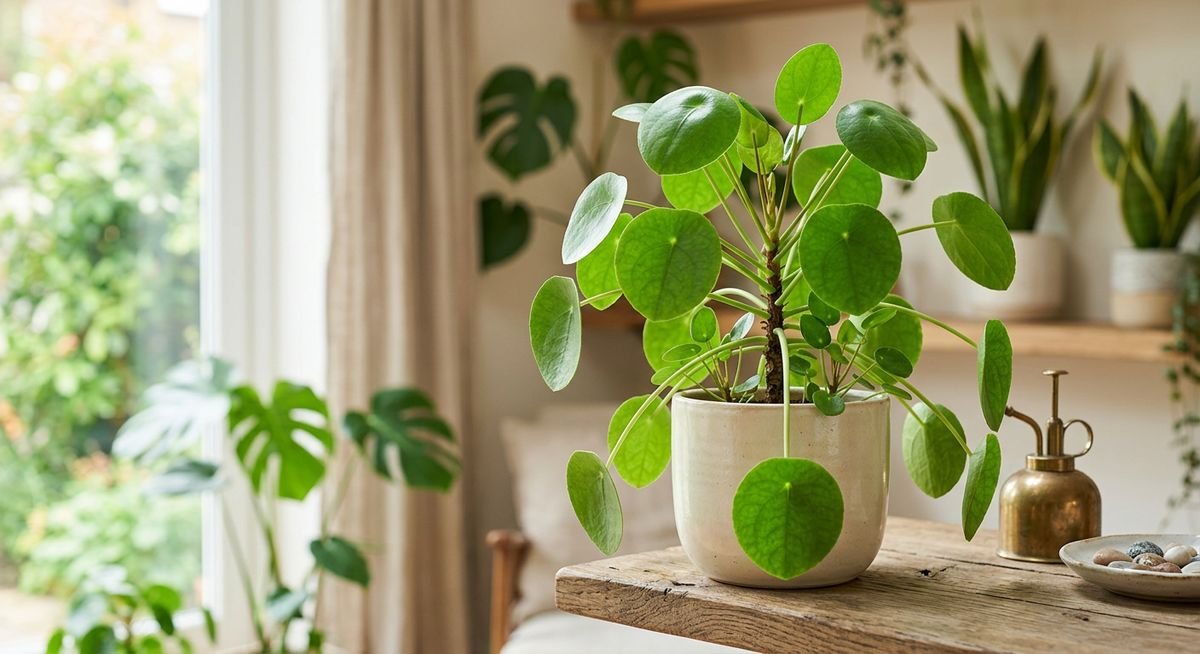
Few houseplants have traveled as far on good word-of-mouth alone as Pilea peperomioides. Those perfectly round, coin-shaped leaves balanced on slender stems look almost too geometric to be real, which is exactly why photos of this plant went quietly viral across Scandinavian homes long before it ever hit mainstream garden centers.
Identifying one is easy once you know the signature: bright green, pancake-flat leaves attached at the center rather than the edge, giving each one the appearance of a tiny floating disc. Nothing else quite looks like it.
Caring for one is equally straightforward, with the right information. Beyond the basics of light and water, there is a full story worth knowing: a DIY soil mix that actually drains, seasonal adjustments that keep the plant thriving year-round, propagation tricks for sharing those irresistible pups, and honest answers on pest problems, leaf discoloration, and whether Pilea peperomioides is safe around pets and children.
What Is Pilea Peperomioides? Origins, Appearance & Size
Pilea peperomioides is a compact, fast-growing tropical perennial native to the Yunnan province of southwestern China. It reaches a mature height of 12 to 18 inches indoors, produces distinctive coin-shaped leaves on long individual stems, and can live well over a decade with basic care.
Botanical History and Native Range
Norwegian missionary Agnar Espegren collected cuttings from wild Pilea peperomioides plants growing in Yunnan’s Cang Mountain region in 1946 and brought them back to Norway. The plant had no commercial availability for decades. Its spread across Europe was entirely person-to-person, passed as cuttings between friends and neighbors. That sharing habit is precisely why it earned the nickname “pass-it-on plant” in Scandinavian households.
Botanists Ib Friis and Knud Rahn formally described the species in 1984, finally giving a scientific name to the plant that had already colonized European windowsills for nearly forty years. Commercial nursery production didn’t scale meaningfully until the 2010s, when social media drove a sudden surge in demand.
That sharing tradition is alive and well. On r/Hamilton, a user recently posted offering free pilea cuttings to neighbors, and the response was immediate. The plant still spreads the same way it always has: one person hands a pup to another.
What Does It Look Like?
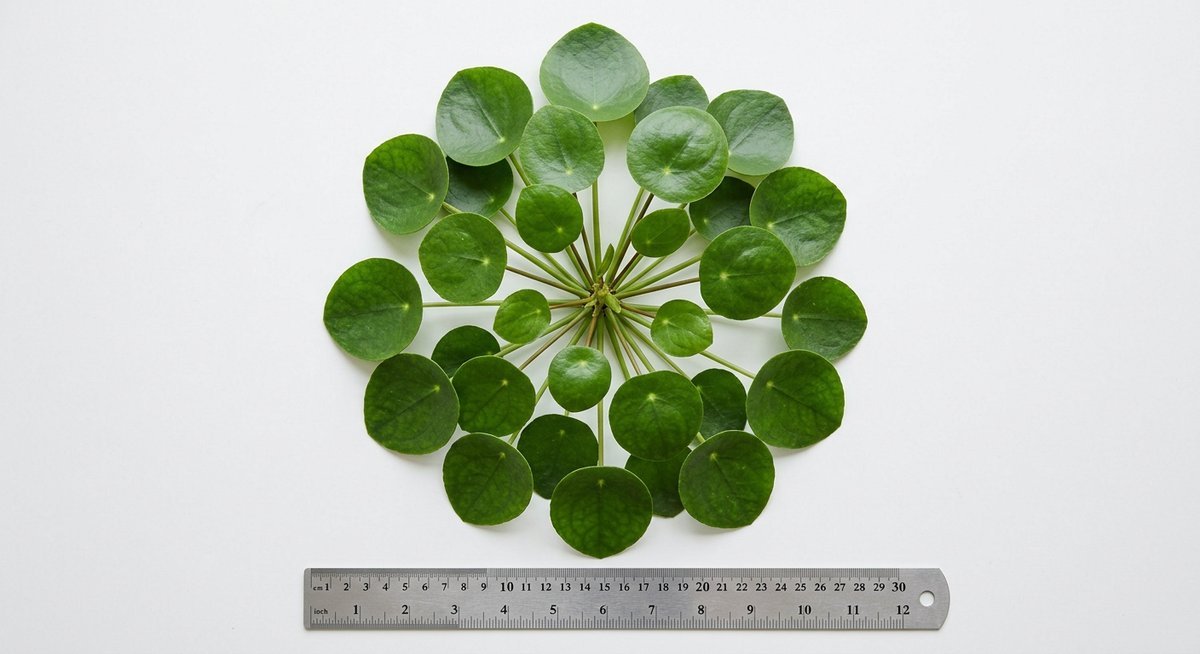
The signature feature is the leaf attachment: each round, bright green leaf connects to its petiole at the center of the blade rather than the edge, a structure botanists call peltate. The result is a pancake-flat, almost perfectly circular disc that can reach 4 inches in diameter on a mature plant.
Common lookalikes include Peperomia polybotrya (raindrop peperomia) and Hydrocotyle vulgaris (pennywort), but neither shares the true peltate attachment. If the stem connects dead-center on the underside of the leaf, it is almost certainly Pilea peperomioides.
How Fast Does It Grow and How Big Will It Get?
Under good conditions (bright indirect light, consistent watering, and regular feeding), Pilea peperomioides adds roughly 4 to 12 inches of growth per year, with the higher end reserved for ideal setups. Most plants reach their mature height of 12 to 18 inches within three to four years.
“This photo was taken 2 years after a friend came to my house with a piece of pilea in a glass of water. Give them light, water (but not too much)…”
— r/houseplants, May 2023 (198 upvotes)
| Growth Stage | Typical Height | Timeframe |
|---|---|---|
| Seedling / offset | 1 to 3 inches | 0 to 6 months |
| Juvenile | 4 to 8 inches | 6 to 18 months |
| Mature | 12 to 18 inches | 3 to 4 years |
| Long-term indoor lifespan | Stable at mature size | 10+ years |
Growth slows noticeably in low light or during winter dormancy. A plant that pushes out a new leaf weekly in summer may stall for six weeks in January. Patience during the cold months pays off once spring arrives.
Pilea Peperomioides Care at a Glance
Pilea peperomioides thrives in bright indirect light, well-draining soil, and moderate watering every one to two weeks. Keep temperatures between 60 and 77 degrees Fahrenheit (15 to 25 degrees Celsius), maintain 40 to 60 percent humidity, and fertilize monthly from March through September. The plant is non-toxic to cats, dogs, and children according to the ASPCA.
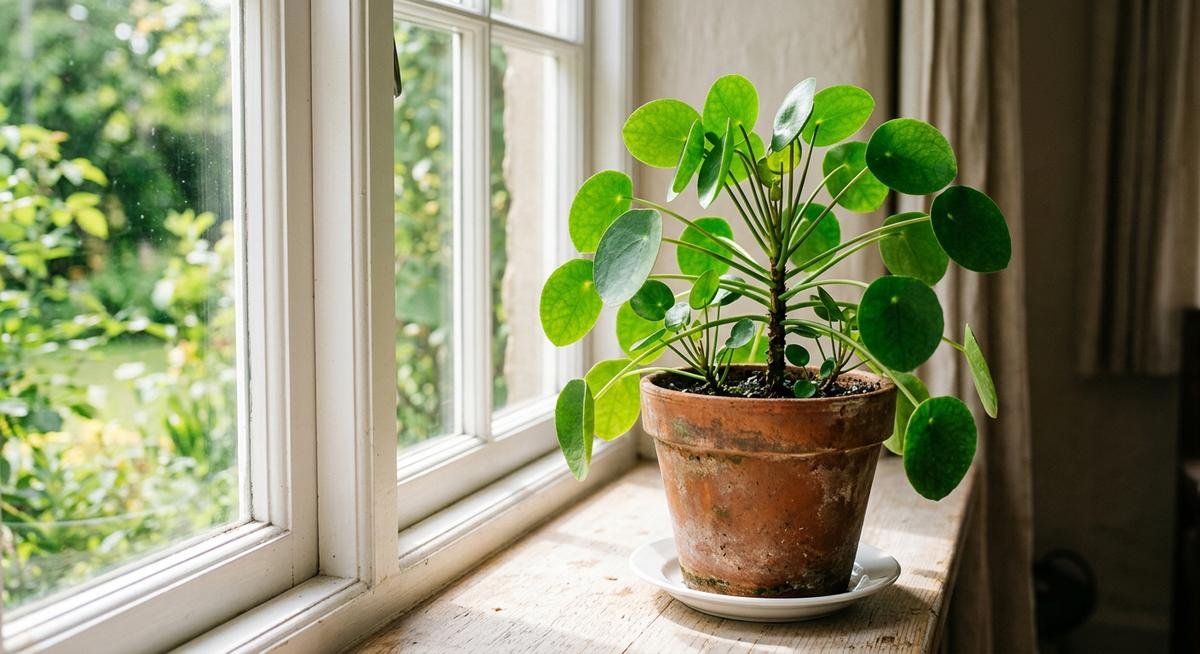
Care Summary Table
| Parameter | Requirement | Quick Note |
|---|---|---|
| Light | Bright indirect | Rotate pot quarterly to prevent lean |
| Water | Every 1 to 2 weeks | Soak and dry; never let roots sit in water |
| Soil | Well-draining mix | 60% potting mix / 30% perlite / 10% coarse sand |
| Temperature | 60 to 77 F (15 to 25 C) | Avoid cold drafts below 50 F (10 C) |
| Humidity | 40 to 60% | Tolerates average household air |
| Fertilizer | Monthly, spring through summer | Balanced liquid, half-strength only |
| Toxicity | Non-toxic | Safe for cats, dogs, and children (ASPCA) |
Light Requirements
Bright indirect light is the sweet spot: the glow of a south- or east-facing window filtered through a sheer curtain, not direct afternoon sun beating on the leaves. Direct sun will scorch those distinctive round leaves fast, leaving pale, papery patches that do not recover.
Too little light tells a different story: stretched stems, smaller new leaves, and a plant that leans dramatically toward the nearest light source. Pilea peperomioides is notorious for this lean, so rotate the pot a quarter turn every three to four weeks to keep growth balanced and symmetrical.
“Very easy to keep growing but will quickly get leggy. Some people in this sub have massively bushy pileas that look just lovely and I can’t seem to master the trick.”
— r/houseplants, a community of 7M+ plant enthusiasts known for candid care advice, May 2023 (47 upvotes)
The “bushy vs. leggy” split often comes down to light intensity. Plants that get consistent bright indirect light from multiple angles (or frequent rotation) tend to stay compact. Plants parked in a dim corner stretch fast.
Watering Schedule
The soak-and-dry method works best. Water thoroughly until it drains freely from the bottom, then wait until the top inch of soil is completely dry before watering again, usually seven to fourteen days depending on season and pot size.
“This plant should be watered like a succulent. Yellow bottom leaves, heavy leaf drop, and the black edges imply over-watering.”
— r/plantclinic, Reddit’s go-to community for plant diagnosis with 1M+ members, February 2020 (109 upvotes)
Overwatering is the leading cause of death for this plant. Yellowing lower leaves and a soft, mushy stem base are the warning signs; if you see both together, root rot has likely already started. Drainage holes are non-negotiable: a pot without them is a slow trap regardless of how careful the watering schedule is.
One detail the community flags consistently: self-watering pots are risky with Pilea peperomioides. These planters keep the root zone constantly moist, which is exactly what this plant does not want. Terracotta with a drainage hole is the safer bet. The porous clay wicks excess moisture away from roots naturally.
Best Soil Mix Recipe
Generic “well-draining soil” advice doesn’t go far enough. A reliable DIY blend is 60 percent standard potting mix, 30 percent perlite, and 10 percent coarse horticultural sand. The perlite creates air pockets that prevent root suffocation, while the sand adds weight that keeps tall specimens stable in their pots.
For extra aeration, swap a portion of the perlite for orchid bark, especially useful in humid environments where the mix stays damp longer. Commercial options like Fox Farm Ocean Forest or Miracle-Gro Indoor Potting Mix work as a base, but amending with perlite is still recommended.
A common mistake plant owners make: repotting too frequently in soil that stays wet too long. As one experienced grower on r/PileaPeperomioides noted, “The issue began after repotting it with soil that stayed wet too long, which is essentially the same as overwatering.” Pick a well-draining mix from the start and you avoid that cascade.
Temperature, Humidity, and Feeding
Standard household temperatures between 60 and 77 degrees Fahrenheit suit this plant perfectly. Cold drafts below 50 F can trigger leaf drop within days, so keep pots away from drafty windows in winter and exterior doors that open frequently.
Humidity of 40 to 60 percent is ideal, though Pilea peperomioides tolerates average household air better than most tropicals. A pebble tray beneath the pot or grouping plants together raises local humidity without a humidifier. Fertilize with a balanced liquid feed (10-10-10 or similar) diluted to half-strength once monthly from March through September. Skip feeding entirely in winter when growth stalls.
Common Pests and Leaf Problems
Pilea peperomioides is not especially pest-prone, but three culprits show up regularly: fungus gnats, spider mites, and mealybugs. Catching them early makes the difference between a minor nuisance and a plant in serious decline.
Pest Identification and Treatment
| Pest | Signs | Treatment |
|---|---|---|
| Fungus gnats | Tiny black flies hovering around soil surface | Let soil dry out fully between waterings; top-dress with sand or use yellow sticky traps |
| Spider mites | Fine webbing on leaf undersides; stippled or dusty-looking leaves | Spray leaves with a strong water stream; follow up with neem oil or insecticidal soap weekly |
| Mealybugs | White cottony clusters in leaf joints and along stems | Dab individual bugs with rubbing alcohol on a cotton swab; treat heavy infestations with neem oil |
Fungus gnats are almost always a watering issue: their larvae thrive in consistently moist soil. Letting the top inch dry completely between waterings eliminates the breeding environment. Spider mites favor dry air, so boosting humidity around the plant makes conditions less hospitable even before treatment begins.
Troubleshooting Leaf Discoloration
| Symptom | Likely Cause | Fix |
|---|---|---|
| Yellowing lower leaves | Overwatering, root rot, or nitrogen deficiency | Check soil moisture first; if soil is dry, try half-strength fertilizer instead of more water |
| Brown crispy leaf edges | Low humidity or underwatering | Increase humidity with a pebble tray; water more consistently |
| Curling leaves (inward) | Too much direct light | Move to a spot with filtered or indirect light |
| Drooping leaves | Underwatering or cold stress | Water thoroughly; move away from cold drafts |
| White spots on leaves | Mineral deposits from tap water | Wipe leaves with a damp cloth; switch to filtered or rainwater |
| Brown/red discoloration | Too much intense light (sun stress) | Move to bright indirect light; damaged leaves won’t recover but new growth will be normal |
Yellowing is the most common complaint, and the instinct is to blame overwatering. That is often correct, but not always. Several experienced growers on r/PileaPeperomioides point to a missed diagnosis: interveinal chlorosis from nitrogen deficiency. If the soil is dry and the yellowing shows between leaf veins rather than across the whole leaf, try a half-strength liquid fertilizer before cutting back on water. Misidentifying a nutrient problem as a watering problem makes things worse, not better.
“The interveinal chlorosis (yellow on the leaves) is a symptom of low nitrogen. Don’t be tempted to just keep watering it. The next time you water add a small amount of water soluble fertilizer.”
— r/PileaPeperomioides, a niche community dedicated to this specific species, January 2026 (5 upvotes)
Before reaching for any treatment, stick a finger an inch into the soil. If it feels damp, wait. If it feels dry and the yellowing pattern is interveinal, feed. That two-step check prevents the majority of Pilea problems.
Propagating Pilea Peperomioides: Pups, Offsets, and Stem Cuttings
Pilea peperomioides propagates most reliably through soil-level offsets called pups, which the mother plant produces naturally once mature. Separate a pup when it reaches 2 to 3 inches tall, pot it in a well-draining mix, and expect an established plant within four to six weeks.
Harvesting Pups (Offsets)
A healthy, mature Pilea peperomioides will push pups up through the soil from its root system, typically appearing in spring and summer. Wait until a pup stands at least 2 to 3 inches tall; smaller than that, and the root system is too underdeveloped to survive separation reliably. Use a clean, sharp knife or sterilized scissors to sever the offset as close to the mother plant’s root as possible, preserving whatever roots the pup has already formed.
Experienced propagators on r/propagation push back on separating pups too early. The consensus: let them get bigger than most guides suggest.
“Let them get bigger. Speaking from experience. Like at least double their current size.”
— r/propagation, a 400K+ member community focused on plant propagation techniques, April 2023
Pot the offset immediately into the same DIY mix recommended for the mother plant: 60 percent potting mix, 30 percent perlite, 10 percent coarse sand. Keep the soil lightly moist for the first two weeks to reduce transplant stress.
Stem Cutting Propagation
Stem cuttings work when a plant produces a bare stem or when you want to propagate a leggy specimen. Cut just below a node using a sterilized blade, then set the cutting aside for one to two hours so the wound can callous slightly, reducing rot risk.
Place the cutting in a small glass of room-temperature water or insert it directly into moist perlite. Roots typically emerge within two to four weeks in water; soil propagation takes slightly longer but produces roots better adapted to growing medium from the start. Some growers swear by sphagnum moss for delicate pilea cuttings: it holds moisture without waterlogging the way soil sometimes can.
| Method | Best Timing | Rooting Timeline | Difficulty |
|---|---|---|---|
| Pup / Offset | Spring through Summer | 4 to 6 weeks to establish | Easy |
| Stem Cutting (water) | Spring through Summer | 2 to 4 weeks to root | Easy |
| Stem Cutting (soil) | Spring | 3 to 5 weeks to root | Moderate |
| Sphagnum Moss | Spring through Summer | 2 to 4 weeks to root | Moderate |
Seasonal Care Calendar for Pilea Peperomioides
Most care guides treat Pilea peperomioides as though conditions never change. They do, and the plant responds to those shifts. Adjusting water, feeding, and light exposure by season keeps growth steady and prevents the problems that come from applying summer routines in winter.
| Season | Watering | Fertilizing | Light Notes |
|---|---|---|---|
| Spring (March to May) | Resume normal frequency as growth accelerates | Begin monthly half-strength feeding | Move closer to windows as daylight increases |
| Summer (June to August) | Water more frequently; soil dries faster in heat | Continue monthly feeding | Shield from harsh afternoon sun; morning light is ideal |
| Fall (September to November) | Gradually reduce frequency as growth slows | Final feed in September, then stop | Maintain position; shorter days reduce light naturally |
| Winter (December to February) | Water sparingly; every 2 to 3 weeks | No fertilizer | Move to brightest available window; supplement with a grow light if needed |
Winter is where most mistakes happen. The instinct to keep watering on a summer schedule leads to waterlogged soil and root rot during a period when the plant barely drinks. Cut back, and the plant will reward you with vigorous spring growth.
One pattern that surprises new owners: fall leaf drop. Multiple growers on r/PileaPeperomioides report that every September and October, the bottom half of their pilea’s leaves wither away, consistently, across multiple plants. This seasonal shedding is normal and not a sign of anything wrong. The plant is redirecting energy to the top canopy as light decreases. If the new growth at the top looks healthy, leave it alone.
Feng Shui, Symbolism, and Gifting
The name “money plant” is not just marketing. It connects to a genuine tradition. In Chinese feng shui practice, round-leafed plants are associated with coin-like energy, and Pilea peperomioides specifically is considered a symbol of prosperity and good fortune. Placing one in the wealth corner of a room (the far left corner from the entrance, according to the bagua map) is a common recommendation among feng shui practitioners.
The plant’s prolific pup production adds a second layer of symbolism: abundance that multiplies and is meant to be shared. Gifting a Pilea offset to a friend is a tradition that predates the internet, rooted in the same Norwegian pass-it-on culture that first spread the plant across Europe. A small pot with a freshly separated pup makes a thoughtful housewarming or lunar new year gift: personal, living, and carrying a quiet wish for prosperity.
Frequently Asked Questions
Is Pilea peperomioides toxic to cats and dogs?
No. Pilea peperomioides is non-toxic to cats, dogs, and children according to the ASPCA. Ingesting a leaf may cause mild stomach upset, but the plant poses no serious poisoning risk.
Why are my Pilea leaves curling?
Inward curling almost always indicates too much direct sunlight. Move the plant to a spot with bright but filtered light and the leaves should flatten out within a week or two. Outward curling, which is rarer, can signal underwatering.
How often should I repot a Chinese money plant?
Repot every 12 to 18 months or when roots begin circling the drainage holes. Choose a pot only one to two inches larger than the current one; oversized pots hold excess moisture that promotes root rot. Avoid repotting more than once in a short period. One experienced grower’s horticulturalist father warned that “repotting three times in 4.5 months is a huge tax on a plant’s resources,” and the plant may struggle to recover from that kind of repeated disruption.
Why is my Pilea leaning to one side?
Pilea peperomioides grows aggressively toward the strongest light source. Rotate the pot a quarter turn every two to three weeks and the growth will even out over time. A south- or east-facing window provides the most balanced illumination.
Can Pilea peperomioides grow in low light?
It survives in low light but does not thrive. Expect leggy stems, smaller leaves, and dramatically slower growth. If a brighter spot is not available, a small LED grow light running 10 to 12 hours daily compensates effectively.
How do I get my Pilea to produce more pups?
Healthy root systems in slightly snug pots produce the most offsets. Ensure the plant receives bright indirect light, consistent watering, and monthly feeding during the growing season. Pups usually appear once the mother plant is at least one year old.
What is the best pot for Pilea peperomioides?
Terracotta with a drainage hole is the best choice. The porous clay wicks excess moisture away from roots, and the weight keeps top-heavy mature plants from tipping. Glazed ceramic and plastic work too, but require more careful watering since they retain moisture longer. Avoid self-watering pots for this species; the constant moisture they provide is a recipe for root rot with a plant that prefers to dry out between drinks.
Should I use a self-watering pot for Pilea?
No. Self-watering pots keep the root zone consistently moist, which is the opposite of what Pilea peperomioides wants. Plant communities flag this as a common mistake. Terracotta or any pot with drainage holes and a soak-and-dry watering rhythm is a much better fit for this species.
Putting It All Together
Pilea peperomioides earned its popularity honestly: a genuinely beautiful plant that happens to be easy to care for and even easier to share. Bright indirect light, a well-draining soil mix, and the discipline to let the top inch dry between waterings cover about 90 percent of what this plant needs from you.
The remaining 10 percent is seasonal awareness: less water in winter, no fertilizer when growth stalls, and a quarter turn of the pot every few weeks to keep the canopy balanced. Get those basics right and the Chinese money plant will reward you with pups to gift, leaves that stay green and flat, and a living fixture on your windowsill for years to come.