


Weeping willows (Salix babylonica) grow 3 to 4 feet per year, reaching 50 to 80 feet tall with a canopy spread of 40 to 60 feet. That speed comes with conditions: full sun, consistently moist soil, and at least 50 feet of clearance from any foundation, sewer line, or septic system. Get the placement right, and few trees reward a homeowner faster. Get it wrong, and the root system will find every buried pipe on the property.
Knowing how to plant weeping willow trees comes down to matching the tree to the right spot. Here is what you need to know about choosing a location, getting the tree in the ground, and keeping it healthy through that critical first year.
Where to Plant a Weeping Willow Tree
Full sun and wet feet. Those two requirements narrow the list of suitable locations faster than anything else. Weeping willows need a minimum of six hours of direct sunlight daily and prefer soil that stays consistently moist or even saturated.
The best spots share a pattern: low-lying areas near ponds, streams, drainage swales, or anywhere water collects after rain. According to the USDA Plant Hardiness Zone Map, this species performs reliably in zones 4 through 9, tolerating winter lows down to -20 degrees Fahrenheit.
Soil type matters less than moisture level. Clay, loam, sandy loam: the tree adapts to all of them as long as water is available. Willows also handle slightly acidic to neutral pH (5.5 to 7.0) without amendment.
One practical use that competitors rarely mention: weeping willows are effective erosion control trees. Their dense root networks stabilize banks along creeks, retention ponds, and storm drains. Municipal stormwater engineers have used them for decades in bioretention areas.
A tree built to survive standing water, thriving in conditions that would rot the roots of almost any oak or maple. That tolerance is what makes site selection so specific, and so important to get right.
How Far to Plant a Weeping Willow from Your House
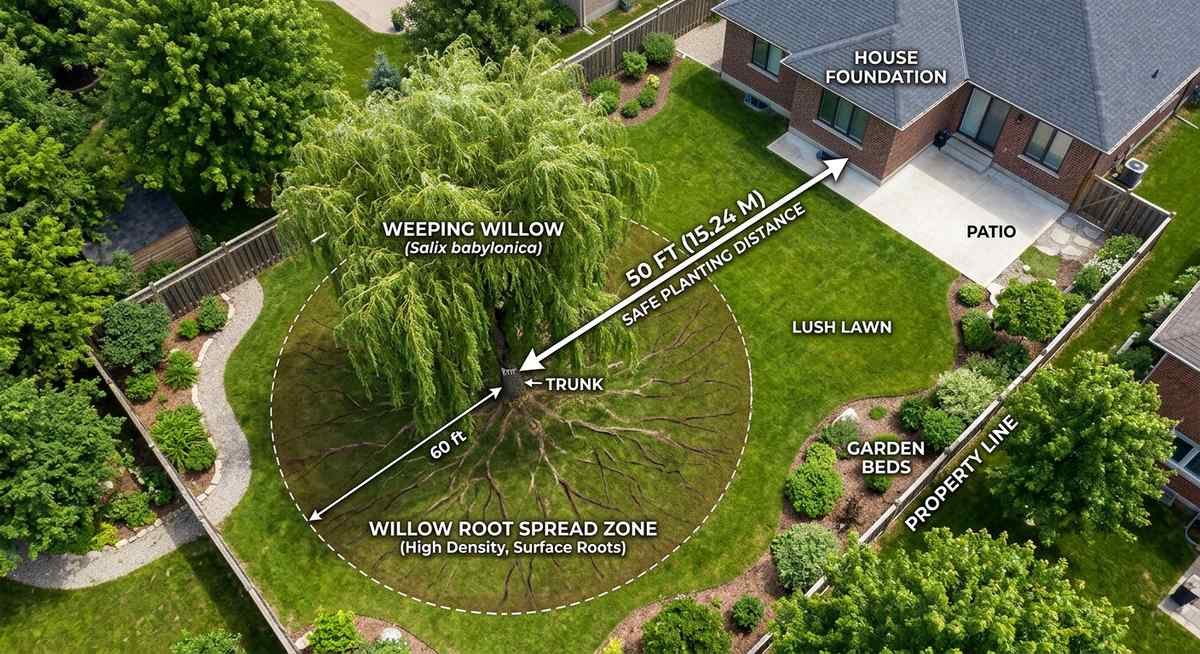
Plant a weeping willow at least 50 feet from any house, garage, sewer line, septic tank, or underground utility. The root system is shallow, lateral, and aggressively water-seeking, spreading as far as 100 feet from the trunk in mature trees.
“We have a weeping willow that was planted too close to the house by previous owners. The roots cracked our sewer lateral and cost us $8,000 to reline.”
— r/arborists, April 2026 (2 upvotes)
This matches what arborists and municipal utility departments consistently report. According to the International Society of Arboriculture (ISA), willow roots are among the top three causes of residential sewer line infiltration in North America. The roots do not break pipes through brute force. They enter through existing joints, cracks, or loose connections, then expand inside, creating blockages.
| Structure | Minimum Distance | Ideal Distance |
|---|---|---|
| House foundation | 50 feet | 75+ feet |
| Sewer/water lines | 50 feet | 75+ feet |
| Septic tank/drain field | 50 feet | 100 feet |
| Sidewalk or driveway | 20 feet | 30 feet |
| Property line | 20 feet | 30 feet |
An $8,000 sewer repair turns a beloved shade tree into an expensive regret. Measure the distance before you dig, not after the plumber arrives.
Step-by-Step Planting Guide
The best time to plant a weeping willow tree is early spring after the last frost, or early fall at least six weeks before the first expected freeze. Both windows give the root system time to establish before temperature extremes hit.
- Select the location. Confirm full sun, moist soil, and a minimum 50-foot buffer from structures and underground utilities.
- Dig the hole. Make it two to three times wider than the root ball and exactly the same depth. The root flare (where the trunk widens at the base) should sit at or slightly above ground level.
- Amend heavy clay if needed. Mix in 20-30% compost or aged bark to improve drainage in dense soils. Skip this step for loam or sandy loam.
- Place the tree. Remove the container or burlap. Set the root ball in the hole, keeping the root flare visible. Straighten the trunk.
- Backfill and settle. Fill the hole halfway, water thoroughly to eliminate air pockets, then fill the rest. Tamp gently with your foot. Do not mound soil above the root flare.
- Water deeply and mulch. Soak the root zone with 2 to 3 gallons. Apply 3 to 4 inches of shredded bark mulch in a ring around the tree, keeping it 3 inches away from the trunk to prevent rot.
| Planting Factor | Requirement |
|---|---|
| Best season | Early spring or early fall |
| Hole width | 2-3x root ball diameter |
| Hole depth | Same as root ball height |
| Soil amendment | Compost for heavy clay only |
| Initial watering | 2-3 gallons at planting |
| Mulch depth | 3-4 inches, 3 inches from trunk |
First-Year Care and Establishment
Water a newly planted weeping willow two to three times per week for the first 90 days, delivering 10 to 15 gallons per session. After that initial window, taper to once weekly through the first full year unless rainfall exceeds 1 inch per week.
Mulch is the single most effective tool for establishment. A 3- to 4-inch layer of organic mulch (bark chips, shredded hardwood) retains moisture, suppresses competing weeds, and regulates soil temperature. Refresh it annually. Pull it back if it creeps toward the trunk.
Staking is usually unnecessary. Weeping willows develop strong central leaders. The exception: exposed sites with consistent wind over 20 mph. In those conditions, use two stakes with flexible ties, positioned perpendicular to the prevailing wind. Remove them after the first growing season.
Watch for stress signals during summer heat: yellowing lower leaves, premature leaf drop, or branch dieback at the tips. All three indicate insufficient water. Increase irrigation frequency before anything else.
Prune in late winter or early spring, before buds break. Remove dead, crossing, or rubbing branches. Avoid heavy structural pruning in the first year. The tree needs every leaf it can produce to build root mass. By year three, most weeping willows develop that iconic cascading canopy, filling 15 to 20 feet of lateral space. The patience of a single restrained growing season pays off in shade coverage that few other species deliver this quickly.
Common Problems and How to Fix Them
Aphids, willow leaf beetle, and crown gall rank as the three most frequent threats to weeping willows, and all three respond well to early intervention before populations establish.
| Problem | Symptoms | Treatment |
|---|---|---|
| Aphids | Sticky honeydew on leaves, curling foliage | Strong water spray; insecticidal soap if heavy |
| Willow leaf beetle | Skeletonized leaves, metallic blue-green beetles | Hand-pick adults; Bt for larvae |
| Crown gall | Rough, rounded growths at trunk base | Remove galls surgically; sterilize tools |
| Willow scab | Dark spots on leaves, premature leaf drop | Improve air circulation; fungicide in severe cases |
| Black canker | Sunken dark lesions on branches | Prune affected branches 6 inches below canker |
Most willow diseases thrive in humid, stagnant air. Proper spacing and selective pruning to open the canopy handle the majority of fungal pressure without chemical intervention.
Growing a Weeping Willow from Cuttings
A 12- to 18-inch stem cutting placed in a jar of water will root within three to six weeks, making the weeping willow one of the easiest hardwood trees to propagate at zero cost.
Take cuttings in late winter or early spring from healthy, pencil-thickness branches of the current year’s growth. Strip the lower leaves, leaving two or three at the top. Place the cutting in a glass or jar with 4 to 6 inches of room-temperature water, and change the water every three days to prevent bacterial buildup.
Once roots reach 3 to 4 inches long, transplant the cutting into a 1-gallon pot with standard potting mix. Keep the soil consistently moist for four to six weeks, then harden off outdoors before transplanting to a permanent location.
“I stuck a willow branch in a bucket of water and forgot about it. Three weeks later it had roots everywhere. Easiest tree I have ever propagated.”
— r/gardening, March 2026 (1 upvote)
This aligns with horticultural research on Salix species. According to the University of Florida IFAS Extension, willows contain naturally high levels of indolebutyric acid (IBA), a plant hormone that promotes root development, which explains their unusually fast rooting response in water.
Frequently Asked Questions
Are weeping willow trees fast-growing?
Yes. Weeping willows grow 3 to 4 feet per year under favorable conditions, reaching 50 to 80 feet tall at maturity. That growth rate ranks them among the fastest-growing shade trees available in North America. Expect a full canopy within five to eight years of planting.
How big does a weeping willow tree get?
A mature weeping willow reaches 50 to 80 feet in height with a canopy spread of 40 to 60 feet. The cascading branches can extend to within a few feet of the ground, creating a dome-shaped silhouette that requires significant yard space.
What does a weeping willow tree symbolize?
Weeping willows have represented grief, mourning, and remembrance across multiple cultures for centuries. In Victorian England, willow motifs appeared on gravestones and memorial jewelry. In Chinese tradition, the tree symbolizes spring, renewal, and feminine grace. Many cemeteries in the United States still plant them as living memorials.
Can I plant a weeping willow in a small yard?
A standard weeping willow is not suitable for small yards. The canopy alone spans 40 to 60 feet, and the root system extends even further. For tight spaces, consider the dwarf weeping willow (Salix integra ‘Pendula’), which matures at 15 to 20 feet tall, or a weeping cherry as an alternative ornamental.
When is the best time to plant weeping willow trees?
Early spring (after the last frost) and early fall (six weeks before the first freeze) are the two ideal windows to plant weeping willow trees. Both periods offer moderate temperatures and consistent rainfall, giving roots time to establish before summer heat or winter dormancy.