
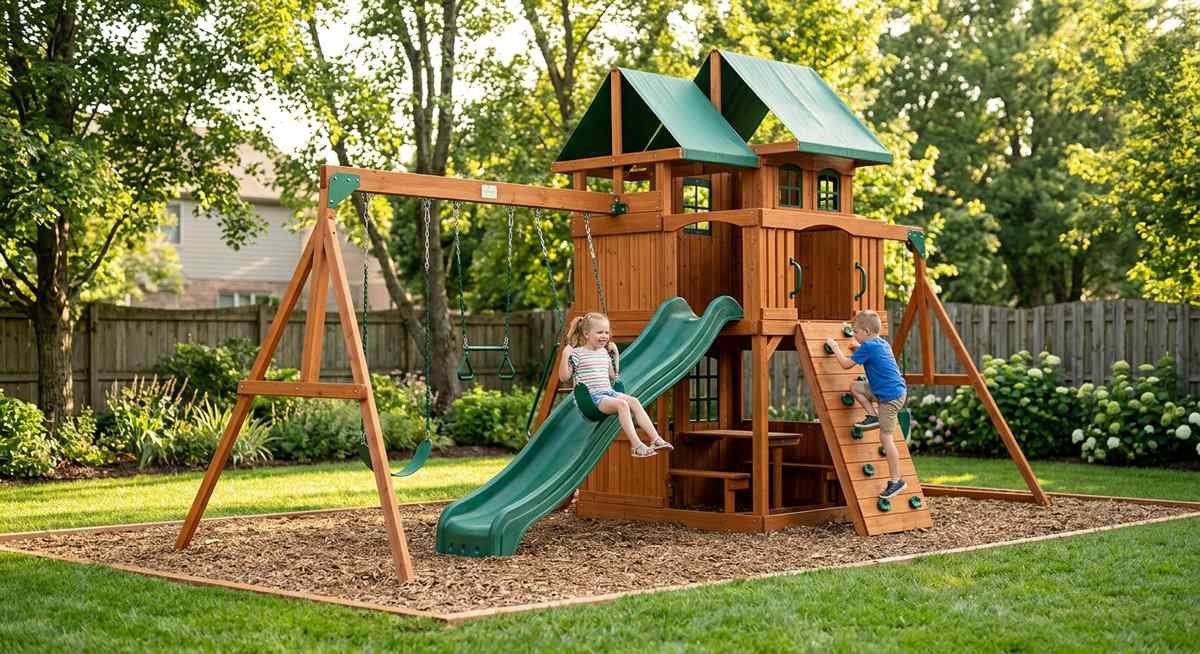
I spent three weekends in April 2024 researching swing sets before pulling the trigger on the Backyard Discovery Woodridge Elite. My kids were 4 and 7, the yard was big enough, and I was tired of driving to the park every time someone wanted to swing.
Here’s what I wish someone had told me before I bought it: the Woodridge Elite is a genuinely solid cedar playset that delivers on its promise — but assembly will test your patience, the safety clearance zone is bigger than you expect, and cedar maintenance is non-negotiable if you want it looking good past year three.
This review covers everything I learned from building, using, and maintaining this set over the past two years — plus real feedback from dozens of parents in online communities who’ve done the same.
Features and Specs at a Glance
The Woodridge Elite measures roughly 16 feet wide by 15 feet deep, supports a combined 800-pound weight capacity across all stations, and is designed for kids ages 3 through 10. It ships with eight distinct play features built from 100% cedar lumber — no pine fillers, no composite framing.
At the time I bought mine, it was priced around $1,400 through Sam’s Club. I’ve seen it fluctuate between $1,200 and $1,600 depending on retailer and season.
Why Cedar Actually Matters
Cedar isn’t just a cosmetic upgrade. Western red cedar contains natural oils — thujaplicin and thujic acid — that resist moisture, fungal decay, and insect damage without chemical pressure treatment. That distinction matters when your kids grip the railings bare-handed for hours, chew on random surfaces (because kids), and press their faces against the wood during pretend play.
The alternative at this price point is usually pressure-treated pine, which achieves similar rot resistance through chemical preservatives like ACQ (alkaline copper quaternary). The EPA considers modern ACQ-treated lumber safe, but most parents I’ve talked to in the swing set community prefer cedar’s chemical-free approach for playground equipment.
Aesthetically, untreated cedar weathers to a soft silver-gray over time. With annual sealing, it holds a warm honey tone. Either way, it looks significantly better than the greenish tint of treated pine. My set has been sealed once a year with Thompson’s WaterSeal, and it still looks great heading into year three.
Play Features Breakdown
Eight activity stations packed into one footprint:
| Activity Station | Count | Weight Capacity | Age Range |
|---|---|---|---|
| Belt Swings | 2 | 115 lbs each | 3-10 years |
| Wave Slide | 1 | 115 lbs | 3-10 years |
| Rock Climbing Wall with Rope | 1 | 115 lbs | 4-10 years |
| Enclosed Upper Deck | 1 | 200 lbs (platform) | 3-10 years |
| Sandbox (ground level) | 1 | N/A | 2-6 years |
| Telescope | 1 | Accessory | 3-10 years |
| Steering Wheel | 1 | Accessory | 3-8 years |
The two belt swings get the most daily use in my household — by a wide margin. The rock climbing wall was a huge hit for the first six months, but my 7-year-old (now 9) has mostly outgrown it. The sandbox is the unsung hero for the younger one. The telescope and steering wheel are fun accessories but honestly aren’t why anyone buys this set.
What I’d change: I wish one of the belt swings was a disc swing or web swing instead. Belt swings are standard, but a disc swing would have extended the age appeal. You can swap one out later for about $30-$40.
Is Your Yard Big Enough? (Mine Almost Wasn’t)
This is where most people underestimate. The set itself is 16 by 15 feet. Not bad, right? Except the ASTM F1148 safety standard requires a 6-foot clearance zone on every side. That turns a 16×15-foot playset into a real-world footprint of roughly 28 by 27 feet of dedicated, open space.
I measured my yard three times before ordering. The fence was closer than I thought. I ended up repositioning the set 2 feet from my original plan to get proper clearance behind the swings — the swing arc needs even more room than the 6-foot minimum suggests.
Minimum Yard Size
A practical minimum is 30 by 30 feet of flat, open ground. Slopes greater than 2% should be leveled before assembly — an unlevel base stresses frame joints and creates uneven swing motion that gets worse over time.
Before you order, go outside with a tape measure and actually stake out 30×30 feet. Include clearance from fences, garden beds, the house, and any trees with low branches. I guarantee the space is smaller than you picture in your head.
Ground Cover: Don’t Skip This
Ground cover is the decision most buyers ignore until the set arrives. Don’t be that person. Natural grass provides almost zero fall protection at the heights kids actually fall from play equipment.
| Ground Cover | Cost (per sq ft) | Fall Protection | Maintenance | My Take |
|---|---|---|---|---|
| Engineered Wood Mulch | $0.50-$1.00 | High (ASTM F1292 rated) | Top up annually | Best overall value |
| Rubber Mulch | $1.50-$3.00 | Very High | Minimal (10+ years) | Worth it if budget allows |
| Pea Gravel | $0.30-$0.60 | Moderate | Rakes out of zone | Budget option, messy |
| Natural Grass | $0 | Low (compacts fast) | Mowing, reseeding | Not enough for real use |
I went with engineered wood mulch at 10 inches deep. For my 28×27-foot zone, it cost about $500 delivered. The mulch meets ASTM F1292 fall-attenuation standards at that depth, which means the surface has been tested to absorb impact from the heights kids fall during normal play. It needs topping up every spring, but it’s manageable.
One thing nobody warns you about: wood mulch migrates. After a month of active play, you’ll have mulch kicked 3 feet outside your border. I added a simple landscape timber border (about $40 in materials) and that solved it.
Assembly: The Honest Version
Backyard Discovery says 6-10 hours with two adults. Let me translate that into reality.
It took me and my neighbor 9 hours across two days. Saturday we did the main tower and deck (5 hours). Sunday we finished the swing beam, slide, and accessories (4 hours). We’re both reasonably handy — I’ve built two storage sheds and he remodeled his bathroom. This build is a legitimate full-day project.
“No one talks about how long it takes to put a swingset together… I got one and it took 24 working hours over two weekends for two adults to put together. For that alone I would not do it again.”
— u/ShebaWasTalking, r/Parenting, May 2023 (11 upvotes)
24 hours is extreme and probably a more complex model, but the sentiment is real. Don’t start this on a Sunday afternoon thinking you’ll finish before dinner.
Tools You Actually Need
| Tool | Required? | Why |
|---|---|---|
| Impact driver | Strongly recommended | Standard drill struggles with lag screws in cedar |
| Rubber mallet | Required | Seats joints without denting the wood |
| 4-foot level | Required | Critical for squaring the tower frame |
| Tape measure | Required | Verify post spacing before fastening |
| Drill with 3/16″ pilot bit | Recommended | Prevents cedar from splitting at lag screws |
| Second adult | Non-negotiable | Several steps physically require four hands |
A dad on r/Costco — a subreddit where members share deals and product experiences from the warehouse retailer — described his Backyard Discovery build experience: “Assembly of the Swing Set was countless hours of mainly working on it solo. May be possible to do it in one weekend with 3-4 people all working on separate things simultaneously.” That matches my experience exactly. Solo assembly is technically possible but miserable.
5 Tips That Actually Save Time
- Don’t fully tighten bolts until the frame is square. Run everything finger-tight through the tower phase, check level and diagonals, then torque down. Tightening as you go locks in misalignment that’s brutal to correct later.
- Pre-drill every lag screw hole. Cedar splits more predictably than pine, but it still splits. A 3/16″ pilot hole takes five seconds and prevents cracked boards that permanently weaken the joint.
- Find the ground anchor step before you start. On the Woodridge Elite, anchor bracket installation happens mid-build. Missing it means partial disassembly later. I flagged that page with a sticky note before touching a single board.
- Check level at every vertical post. A 1-degree error at the base compounds into visible lean at the top. Kids notice uneven swinging immediately.
- Have someone read the next step aloud while you work. The biggest time-saver in any two-person build is eliminating the pause between steps. One person reads ahead, the other keeps hands on the structure.
Another parent on r/daddit shared a frustrating assembly moment with a Backyard Discovery Cloud Peak model: “I’m in the middle of my install and the ladder is falling off because it is supposed to be held by two bolts but not screwing into anything!” The community troubleshot it — turned out the piece was installed 180 degrees off, hiding the pre-drilled holes. Lesson: if something doesn’t line up, check orientation before forcing it.
Safety and Weight Limits
The Woodridge Elite meets ASTM F1148 standards for residential play equipment. That’s not marketing language — ASTM F1148 establishes specific requirements for structural integrity, entrapment hazards, protrusion risks, and hardware specs. A product meeting this standard has been designed against benchmarks that genuinely reduce injury risk.
The Consumer Product Safety Commission (CPSC) recommends inspecting residential play equipment hardware at least twice yearly for wear, corrosion, and loosening. I check mine every three months — it takes 15 minutes and catches problems before they become dangerous.
Weight Capacity Per Station
Each station has its own load rating. This matters because multiple kids use the set simultaneously:
| Station | Weight Limit | Age Range |
|---|---|---|
| Each Belt Swing | 115 lbs | 3-10 years |
| Wave Slide | 115 lbs | 3-10 years |
| Rock Climbing Wall | 115 lbs | 4-10 years |
| Upper Deck Platform | 200 lbs | 3-10 years |
| Total Structure | 800 lbs combined | 3-10 years |
Realistically, this set serves kids ages 3 through 10. My now-9-year-old is starting to lose interest in the climbing wall. By 10-11, most kids outgrow the challenge level. Families with kids currently aged 4-8 will get the most years of active use.
The real sweet spot: A household with 2-3 kids spanning ages 3-8. You’ll get five to seven solid years before the set transitions from daily-use equipment to occasional-use yard furniture.
Cedar Maintenance (What Actually Happens After Year One)
With annual maintenance, cedar swing sets last 10-15 years. Without it, expect splintering by year four and structural softness by year six. I’ve seen both outcomes in my neighborhood.
Cedar’s natural oils resist rot and insects, but those oils deplete over time — especially under UV exposure and freeze-thaw cycles. Sealing replenishes that protection. It’s not optional if you want longevity.
Annual Maintenance Calendar
| Season | Task | Time |
|---|---|---|
| Spring | Full inspection, sand rough spots, apply sealant or stain | 2-3 hours |
| Summer | Check hardware for rust or loosening, tighten bolts | 30 minutes |
| Fall | Clear debris from joints, check for moisture traps | 30 minutes |
| Winter | Remove swing seats in freeze zones, cover if possible | 15 minutes |
Spring is the critical window. After winter, inspect every board for cracks, raised grain, or soft spots. Sand rough areas with 80-grit sandpaper, then apply a UV-protective sealant — I use Thompson’s WaterSeal, but Cabot Australian Timber Oil is another solid option.
In high-UV climates (Southwest) or consistently wet areas (Pacific Northwest), seal twice a year. That extra hour of work in fall makes a real difference.
Hardware Wears Out Before Cedar Does
Cedar handles weather well. The metal hardware doesn’t. Check all bolts, S-hooks, and swing hangers every three to six months. Replace any S-hooks that have opened beyond a 0.04-inch gap. Swap out frayed rope or cracked plastic immediately.
Staying ahead of hardware wear is the most overlooked part of swing set ownership. I keep a small ziplock bag of replacement bolts and washers in my garden shed specifically for this.
Is a Backyard Swing Set Worth It?
This is the question underneath all the specs and assembly details. After two years with the Woodridge Elite, my honest answer: absolutely — but only if your kids are in the right age window and you commit to the maintenance.
“The nice thing about a swing set in your yard versus a park is that you can just send your kids out there to play.”
— u/sketchahedron, r/Parenting, May 2023 (244 upvotes)
That convenience factor is massive. On weekday evenings when I’m cooking dinner, I can open the back door and the kids are occupied for 30-45 minutes. No car ride, no packing snacks, no navigating a crowded park.
“The swing set doesn’t have to stay forever! I had one as a kid until I was a tween, and then we removed it for more space. Little kids don’t need lots of room for sports. But when they don’t need it anymore and want that room, you can get rid of it.”
— u/beginswithanx, r/Parenting, May 2023 (428 upvotes)
That’s the right framing. A swing set isn’t a permanent commitment to your yard. It’s 5-8 years of heavy use during the ages when outdoor play matters most. When your kids outgrow it, list it on a local buy-nothing group or sell it for a few hundred dollars. As u/GamesFranco2819 put it on r/daddit (133 upvotes): “Toss it up on a local buy nothing group with the stipulation that whoever wants it must take it apart. Plenty of parents would love one but may not be financially able to secure one.”
Not everyone agrees, though. One parent on r/Parenting shared the opposite experience: “We had our swingset for 15 years and it still gets daily use by my 12 and 9 year old. We have a good sized yard though.” Mileage varies by family.
How It Compares to Other Models
The Woodridge Elite sits in the mid-to-upper range of the Backyard Discovery cedar lineup. Here’s how it stacks up:
| Model | Price Range | Key Difference | Best For |
|---|---|---|---|
| Woodridge Elite | $1,200-$1,600 | 8 stations, all-cedar, sandbox | Best balance of features vs. cost |
| Skyfort All Cedar | $1,500-$2,100 | Larger clubhouse, taller slide | Bigger yards, bigger budgets |
| Tucson Cedar | $800-$1,100 | Simpler layout, fewer stations | Smaller yards, younger kids |
Gorilla Playsets is the other brand that comes up constantly. As u/Single-Intention-535 shared on r/Preschoolers: “We have a Gorilla playset. Granted it’s only about 8 months old so can’t speak to longevity but it wasn’t wildly expensive. We paid a couple hundred bucks for the company to install it.” Professional installation is available for Gorilla but generally not for Backyard Discovery models — something to consider if assembly sounds overwhelming.
For families wanting the most activity stations per dollar in an all-cedar set, the Woodridge Elite hits the strongest balance. If you need something smaller, the Tucson is solid. If money isn’t the constraint, the Skyfort is the upgrade.
Where to Buy
The Woodridge Elite is available through:
- Sam’s Club — Often the best price; where I bought mine
- Amazon — Convenient but pricing fluctuates
- Home Depot — Good for local pickup (seasonal stock, spring through early summer)
- Backyard Discovery website — Direct purchase option
The package weighs over 300 pounds across multiple boxes. Someone needs to be home for delivery. I’d recommend having a friend available to help move the boxes from the driveway to the build site — dragging them alone across the yard is not fun.
Pro tip: Buy in late winter or early spring for the best prices. By May-June, demand spikes and prices often jump $100-$200. I ordered mine in March and saved about $150 compared to the June price.
Frequently Asked Questions
Is the Woodridge Elite really all cedar?
Yes. All structural and decorative wood components are 100% cedar. Hardware, swing chains, the slide, and plastic accessories are obviously non-wood. The distinction matters because some competitors marketed as “cedar” actually use cedar-stained pine for secondary framing.
How long does assembly take?
Plan for 8-10 hours with two adults on a first build. Backyard Discovery pre-drills many bolt holes and color-codes hardware bags by phase, which helps. An impact driver (not just a standard drill) is the single biggest time-saver for lag screw sections.
What is the total weight limit?
800 pounds combined across all stations. Individual stations range from 115 lbs (swings, slide, climbing wall) to 200 lbs (upper deck platform). Multiple kids using different stations simultaneously is explicitly accounted for in the structural design.
How much yard space do I need?
The footprint is 16 by 15 feet, but ASTM F1148 safety clearance pushes the real requirement to about 28 by 27 feet. A 30×30-foot area is the practical minimum once you account for swing arc clearance.
Why cedar over pressure-treated pine?
Cedar resists moisture, insects, and decay through natural oils — no chemical preservatives needed. That matters for playground equipment that kids grip bare-handed for hours. Cedar also splinters less as it ages and looks better long-term.
How long will this swing set last?
With annual sealing: 10-15 years. Without maintenance: expect serious deterioration by year 4-5. The cedar itself is durable, but UV and moisture will break down unprotected wood. Budget 2-3 hours per year for spring maintenance.
Final Verdict
After two years with the Woodridge Elite, I’d buy it again. The all-cedar construction, eight activity stations, and ASTM F1148 safety compliance make it one of the strongest mid-range residential playsets available. It’s not the cheapest option, and it shouldn’t be.
Assembly takes a full day and tests your patience. Annual cedar sealing adds about two hours of maintenance. The safety clearance zone is bigger than most people expect. But the payoff — opening the back door and watching your kids play independently while you cook dinner — makes it genuinely worth it.
The families who get the most from this set are the ones who measure their yard correctly, commit to the maintenance calendar, and buy while their youngest is still 3-4 years from outgrowing it.
Need a place to store your assembly tools and outdoor equipment? Check out our Garden Shed Collection — designed for families who actually use their backyards.